
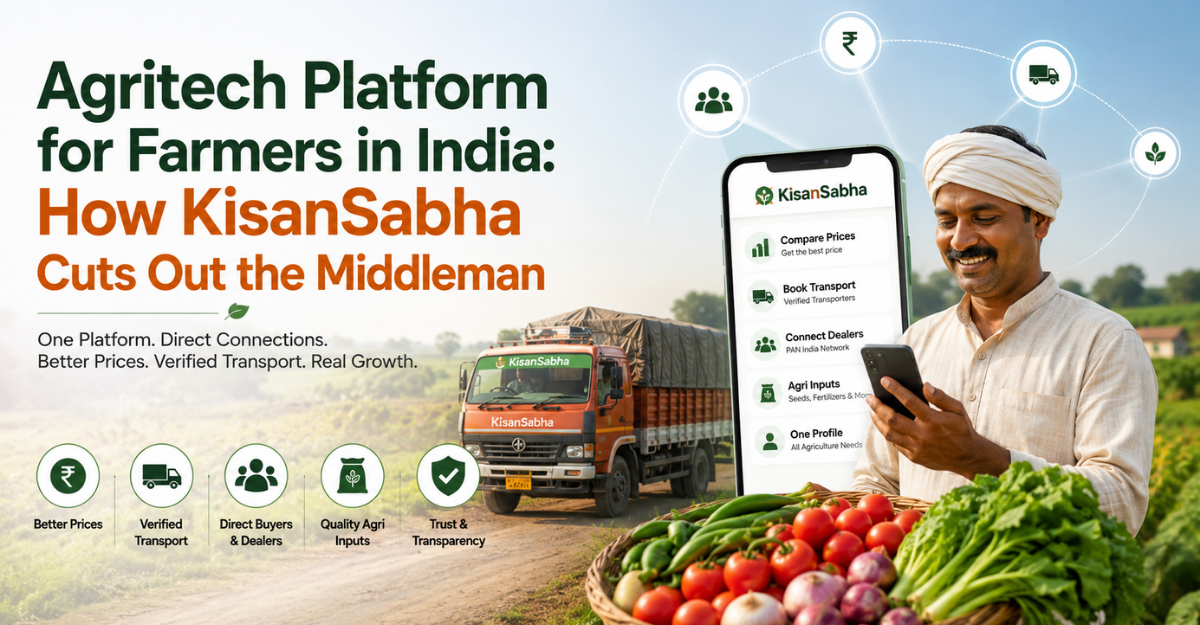
An agritech platform for farmers in India is a digital marketplace that connects growers directly with buyers, transporters, and input dealers – replacing chains of middlemen with one shared network. KisanSabha is one such agritech platform, built specifically to solve the price, transport, and trust problems Indian farmers face every harvest season.
- Agritech platforms remove middlemen by letting farmers, dealers, and transporters transact directly on one network.
- India’s agriculture sector contributes close to 18% of GDP while employing about 45% of the workforce – a productivity gap agritech is designed to close.
- Indian agritech startups have raised well over a billion dollars in funding in recent years, signaling strong investor confidence in the model.
- KisanSabha lets farmers compare prices, book verified transport, and connect with agri-service providers from one profile.
- Listing a farm, agri-business, or transport service on KisanSabha is free to start and takes only a few minutes.
What Is an Agritech Startup?
An agritech startup is a technology-driven business that applies software, data, or logistics tools to agriculture – spanning crop advisory apps, farmer-to-buyer marketplaces, supply-chain platforms, and agri-input e-commerce. Rather than replacing farming itself, an agritech startup replaces the inefficient middle layer between a farm and the market: unreliable transport, opaque pricing, and multiple commission-taking intermediaries.
In India specifically, this middle layer is where most farmer income gets lost. A farmer might grow a strong crop, only to sell it two or three price-cuts below market rate simply because there was no direct route to a buyer or a truck available on time.
The Real Cost of India’s Middleman-Heavy Agri Supply Chain
Agriculture contributes close to 18% of India’s GDP while employing roughly 45% of the national workforce – a mismatch that points directly at low per-farmer productivity and value capture, not low effort. Much of that gap sits in the supply chain rather than the field: multiple intermediaries (arhtiyas, local brokers, sub-dealers) each take a cut before produce reaches the end buyer, and each additional link adds delay, spoilage risk, and price erosion.
This is also why investor capital has moved into the space so quickly. Indian agritech startups have collectively raised well over a billion dollars in venture funding over the past several years, even as overall funding activity across sectors has tightened – a signal that the underlying problem (an inefficient, multi-layered supply chain) is large enough to justify sustained investment in digital fixes.
Why Indian Farmers Are Turning to Agritech Platforms
Indian agriculture is digitizing fast, but not because farmers suddenly became tech enthusiasts – it’s because the old system has clear, repeated pain points:
- Farmers often lose a meaningful share of their sale value to middlemen
- Unpredictable weather makes timing a sale even more urgent
- Getting a fair, transparent price is genuinely hard without market visibility
- Finding a truck at harvest time, when everyone needs one, is a recurring bottleneck
- Sourcing quality seeds and fertilizer at fair rates is its own separate struggle
An agritech platform exists to close exactly this gap – not with a single app feature, but by rebuilding the whole chain: discovery, pricing, transport, and payment, in one connected system.
Traditional Mandi Trading vs. Agritech Platforms
| Factor | Traditional Mandi Chain | Agritech Platform (e.g. KisanSabha) |
| Number of middlemen | Multiple (arhtiya, broker, sub-dealer) | Direct farmer-to-buyer/dealer connection |
| Price transparency | Limited, negotiated locally | Comparable across listed buyers |
| Transport arrangement | Farmer arranges separately, often last-minute | Built-in verified transporter network |
| Payment speed | Can be delayed through the chain | Faster, more direct settlement |
| Access to buyers/dealers outside the local mandi | Rare | Nationwide directory access |
| Access to agri-inputs (seed, fertilizer) | Local dealer only | Multiple listed dealers, comparable pricing |
| Cost to join | N/A (informal) | Free registration to start |
This table is the kind of structured comparison that both Google’s featured snippets and AI answer engines (ChatGPT, Perplexity, AI Overviews) tend to pull directly into their responses, because it answers “agritech vs. traditional mandi” in a single glance.
How an Agritech Platform Like KisanSabha Actually Works
Direct Farmer-to-Buyer Connections
KisanSabha removes the layered middleman structure by letting farmers list produce and talk directly to dealers and buyers. Fewer hands in between means the farmer keeps more of the final sale price, and the buyer gets fresher produce at a fairer rate.
Verified Transport Network
Instead of scrambling for a truck during peak harvest, farmers on KisanSabha connect with transporters already active on the network -ith agreed rates, real-time tracking, and less waiting time between harvest and delivery.
Real-Time Price Comparison
Farmers can compare prices across buyers and regions before committing to a sale, and similarly find competitive rates on seeds, fertilizer, and other inputs, instead of accepting the first (or only) quote available locally.
Access to Agri-Inputs and Experts
Beyond selling produce, the same network gives farmers a way to source better-quality inputs and connect with agricultural experts for advice – turning a single profile into a year-round tool, not just a harvest-season one.
Who Benefits from an Agritech Marketplace
For Farmers: Sell directly to buyers, get better prices, book reliable transport, source quality inputs, and connect with agricultural experts – all from one account.
For Dealers: Buy directly from farmers, secure consistent produce quality, and build long-term sourcing relationships without repeated broker involvement.
For Transporters: Access a steady stream of load requests, negotiate fair rates, and grow a verified reputation on the network.
For Agri-Startups & Service Providers: List cold storage, godowns, agri-instruments, insurance, or advisory services in front of an audience that is actively searching for them -a far more targeted funnel than general advertising.
Does This Work for Small and Marginal Farmers?
Yes – arguably more than for large farms. Small and marginal farmers are the group that historically has the least bargaining power with local middlemen, since they lack the volume to negotiate directly with big buyers. A directory-based agritech platform changes that dynamic by giving every registered farmer, regardless of landholding size, the same visibility to buyers, dealers, and transporters. A smartphone and a free registration replace what used to require scale or local relationships built over years.
How to List Your Agri Business on an Agritech Directory
Getting listed on an agritech platform like KisanSabha typically takes four simple steps:
- Sign up on the platform with your basic business or farm details.
- Create your profile, selecting your category – farmer, dealer, transporter, or agri-service provider.
- Start connecting with buyers, sellers, or transporters already active on the network.
- Grow your business using price comparisons, direct messaging, and the built-in directory reach.
No upfront cost is required to get started, which is one of the more overlooked advantages of joining an agritech directory early – visibility compounds as the network grows, and early listings tend to build trust and transaction history faster than late ones.
Frequently Asked Questions
An agritech startup is a technology company that applies digital tools – marketplaces, advisory apps, or logistics platforms to solve problems in farming, from crop planning to selling produce, replacing inefficient middlemen with direct, data-backed connections.
They help farmers get fairer prices, find reliable transport, access quality seeds and fertilizer, and connect directly with buyers and dealers — cutting out layers of commission-taking intermediaries in the traditional mandi chain.
By joining a farmer-to-buyer marketplace platform, listing their produce, and connecting directly with registered dealers or buyers who can view pricing and place orders without a broker in between.
KisanSabha is one such platform -a marketplace bringing farmers, mandi dealers, transporters, and agricultural service providers into a single network for direct trading and logistics.
Most agritech directories, including KisanSabha, offer free basic registration, with optional paid packages for extra visibility or premium features
Traditional mandi trading routes produce through multiple middlemen with limited price visibility, while agritech platforms connect farmers and buyers directly, with transparent pricing and built-in transport coordination.
Sign up on the platform, choose your category (such as agri-startup or service provider), complete your profile, and your listing becomes visible to farmers, dealers, and buyers searching that category.
Exact national loss figures vary by study, but the underlying driver is well documented: agriculture employs about 45% of India’s workforce while contributing only around 18% of GDP, a gap widely attributed to low productivity and value loss across a fragmented, middleman-heavy supply chain.
Yes. Small and marginal farmers typically gain the most, since a shared directory gives them the same visibility to buyers and transporters that previously required scale or long-standing local relationships.
Yes. Small and marginal farmers typically gain the most, since a shared directory gives them the same visibility to buyers and transporters that previously required scale or long-standing local relationships.
The Bottom Line
India’s agriculture problem was never a shortage of effort – it’s a supply chain built for a different era, still running on layers of intermediaries between the field and the buyer. An agritech platform doesn’t try to reinvent farming; it removes the friction sitting between a good harvest and a fair price: opaque pricing, last-minute transport scrambles, and commissions that stack up before a single rupee reaches the farmer.
That’s the specific gap KisanSabhahttps://kisansabha.in/ is built to close. Not as a funding story or an industry ranking, but as a working network where a farmer, a dealer, a transporter, and an agri-service provider can find each other directly, compare terms transparently, and transact without a broker sitting in the middle of every step. Registration is free, the profile takes minutes to set up, and the value compounds the earlier a business joins – visibility and trust on any directory build over time, not overnight.
Whether you’re a farmer tired of accepting whatever price is offered, a dealer looking for consistent sourcing, a transporter chasing steadier loads, or an agri-startup trying to reach an audience that’s actually searching for what you offer – the fix isn’t a new app to check occasionally. It’s one network where all four sides of the transaction already meet.