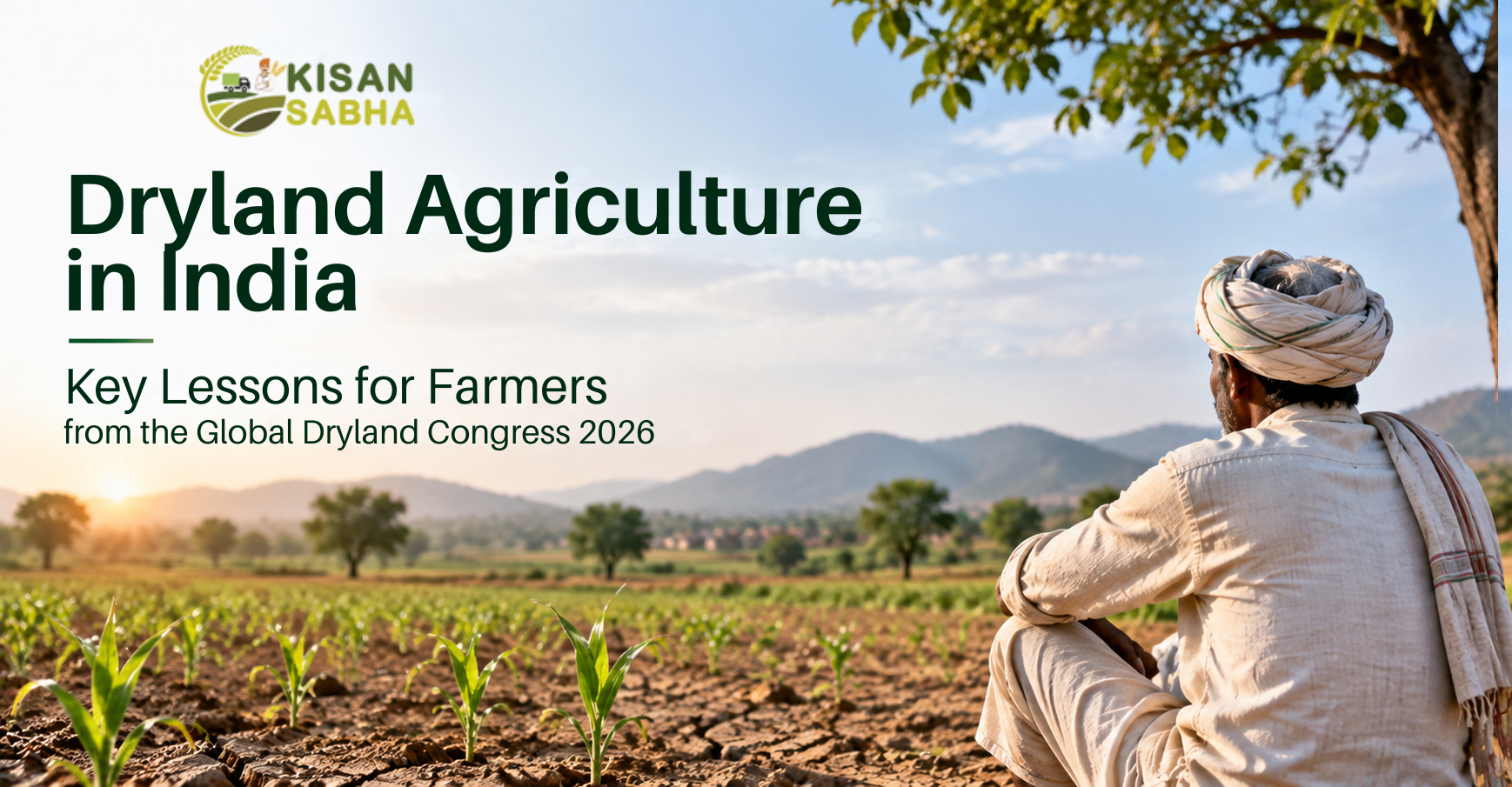
Farming becomes more difficult when rainfall is uncertain, water is limited and weather conditions keep changing. For farmers working in dryland regions, these challenges can directly affect crop growth, farm income and long-term soil health.
This is why dryland agriculture is receiving greater attention from agricultural researchers, policymakers and farming organisations around the world.
The Global Dryland Congress 2026, held in New Delhi from 10 to 12 September, brought together scientists, policymakers, farmer representatives and development partners to discuss how dryland agriculture can become more resilient and sustainable. The Congress was jointly organised by the Indian Council of Agricultural Research (ICAR) and the International Crops Research Institute for the Semi-Arid Tropics (ICRISAT). More than 800 participants were expected to take part across the three-day programme.
But what does a global agricultural conference mean for an Indian farmer?
The answer lies in the practical issues discussed during the Congress — climate resilience, crop improvement, water management, seed systems, farming practices, markets, technology and better access to agricultural knowledge.
What Is Dryland Agriculture?
Dryland agriculture refers to farming systems where crop production depends heavily on rainfall and where irrigation water is limited or unreliable.
Unlike fully irrigated farming, dryland farming requires farmers to make careful decisions about:
- Which crop to grow
- When to sow
- How to conserve soil moisture
- Which seed variety to select
- How much water to use
- How to manage changing weather conditions
- Where and when to sell the produce
Dryland regions face several connected challenges, including drought, soil degradation, climate variability, water shortages and market limitations. ICRISAT notes that drylands cover a substantial share of the world’s land surface and support more than two billion people, making their productivity important not only for farmers but also for food and nutrition security.
For Indian farmers, this makes dryland agriculture more than an environmental issue. It is also a question of productivity, income and food security.
Why Dryland Farming Matters for Indian Farmers
India has many agricultural regions where rainfall plays a major role in determining crop performance.
When rainfall arrives at the wrong time, is unevenly distributed or remains below expectations, farmers can face difficult choices. A crop may be sown on time but later suffer because of a dry spell. Heavy rainfall in a short period can create another problem by causing runoff instead of allowing enough water to remain available in the soil.
This is why successful dryland farming cannot depend on rainfall alone.
Farmers need a combination of better crop choices, soil management, water conservation, weather information, quality seeds and access to markets.
The Global Dryland Congress placed many of these areas at the centre of its discussions.
What Was the Global Dryland Congress 2026 About?
The 2026 Congress was organised around the theme “Transforming Dryland Agriculture with South–South Cooperation.”
The programme covered major areas including crop breeding, climate-resilient landscapes, nutrition and markets, farming systems, seed systems, and gender- and youth-centred agricultural transformation.
The important point for farmers is that these subjects are closely connected.
A drought-resistant crop alone cannot solve every farming problem. Farmers also need suitable seeds, knowledge about cultivation, access to water-saving practices, reliable information and a market for the final produce.
That is why dryland agriculture increasingly requires a whole-farm approach.
1. Choose Crops With Local Climate Conditions in Mind
One of the key areas discussed at the Congress was crop breeding for dryland conditions.
Crop varieties can differ significantly in their ability to handle heat, water stress, disease and shorter growing periods.
For a farmer, this means that selecting a crop should not be based only on last year’s market price.
The local rainfall pattern, soil type, water availability and expected growing season also matter.
A crop that performs well under one set of conditions may not perform equally well in another region.
Farmers should therefore consider locally suitable and recommended varieties and seek guidance from reliable agricultural sources before changing their crop plan.
2. Water Management Is Central to Dryland Farming
When water is limited, every drop matters.
Dryland farming requires greater attention to keeping available water in the field for as long as possible.
Depending on the local conditions, farmers can explore practices such as:
- Rainwater harvesting
- Mulching
- Soil-moisture conservation
- Contour-based field management
- Efficient irrigation methods where irrigation is available
- Appropriate crop spacing
- Crop planning according to expected rainfall
The objective is simple: use available water more efficiently and reduce unnecessary loss.
Water management should also begin before a crop faces visible stress. Planning ahead can give farmers more options during dry periods.
3. Soil Health Should Not Be Ignored
Water and soil are closely connected.
Healthy soil can support better root development and help retain moisture. Poor soil management, on the other hand, can increase erosion and reduce the productive capacity of farmland over time.
Farmers can consider practices suited to their local conditions, such as adding organic matter, reducing unnecessary soil disturbance, using crop residues appropriately and maintaining suitable crop rotations.
There is no single soil-management method that works everywhere.
The right approach depends on soil type, crop, rainfall, available resources and local recommendations.
4. Climate-Resilient Farming Is About Preparation
Climate-resilient agriculture does not mean predicting every weather event.
It means preparing the farm to handle uncertainty better.
For example, farmers may reduce risk through:
- Crop diversification
- Suitable crop varieties
- Better sowing decisions
- Soil-moisture conservation
- Weather-based farm planning
- Efficient use of farm inputs
- Alternative income opportunities where appropriate
This approach changes the question from “How do I recover after a crop problem?” to “How can I reduce the risk before it happens?”
That shift is important for small and medium farmers who may have limited resources to absorb a major crop loss.
5. Better Seeds Can Make a Practical Difference
Seed systems were another important theme of the Global Dryland Congress.
For farmers, seed quality is not simply a technical issue.
Poor-quality or unsuitable seed can affect germination, plant growth and final yield.
Farmers should therefore purchase seeds through reliable sources and check the crop variety, certification or relevant quality information where applicable.
More importantly, the best seed is not necessarily the same for every farmer.
A variety should be considered in relation to the local climate, soil, water availability, crop duration and farming objective.
6. Agricultural Technology Can Improve Decision-Making
Technology is becoming increasingly important in farming, but technology is useful only when it helps farmers make better decisions.
Weather information can help with crop planning.
Digital agricultural platforms can improve access to information.
Market information can help farmers understand prices and demand.
Digital tools can also connect farmers with buyers, agricultural services and other parts of the supply chain.
The Congress highlighted the importance of stronger data and information systems for dryland agri-food systems. ICAR leadership also called for innovation environments that can connect research, practice and policy.
For farmers, the message is straightforward:
Good information at the right time can be as important as good inputs.
7. Production Is Only One Part of Farming
A farmer’s challenge does not end when the crop leaves the field.
A successful agricultural system also depends on storage, transportation, market access, price discovery and timely sales.
This is particularly important in dryland areas because farmers may already be managing higher production risks.
If a farmer produces a good crop but cannot access a suitable market or loses value because of poor post-harvest handling, the benefit of improved production can be reduced.
This is why the Congress also included nutrition and markets among its major themes.
For farmers, climate resilience and market resilience need to be considered together.
What Is the Delhi Declaration on Drylands?
One of the major outcomes of the Global Dryland Congress 2026 was the adoption of the Delhi Declaration on Drylands (3D).
The declaration sets out a shared agenda focused on collaboration, knowledge exchange, innovation and collective action to transform dryland agriculture across the Global South. It was endorsed at the closing session by participating governments, institutions, partners and delegates.
The closing discussions also highlighted the need for stronger data and information systems and for approaches that connect agricultural research with real-world farming and policy.
For farmers, this is significant because agricultural research creates the greatest value when knowledge can move from laboratories and research institutions into practical farm-level solutions.
What Can Indian Farmers Take Away From the Congress?
The biggest lesson is that dryland farming cannot be addressed through one solution.
A more resilient farm may require several small improvements working together.
1. Plan around water availability
Understand how much water is realistically available before selecting crops and planning the season.
2. Select suitable crops and varieties
Consider local climate, soil, crop duration and water requirements.
3. Protect soil moisture
Use suitable moisture-conservation practices for the local farming system.
4. Use reliable agricultural information
Weather, crop and market information can support better decisions when used correctly.
5. Think beyond production
Storage, transport and market access are also part of farm profitability.
6. Keep learning
Agricultural practices are changing. Farmers can benefit from reliable advice from agricultural universities, Krishi Vigyan Kendras, government departments and trusted agricultural platforms.
How Can KisanSabha Support the Future of Indian Agriculture?
The future of agriculture is not only about producing more.
It is also about helping farmers make better-informed decisions.
Digital agricultural platforms such as KisanSabha can play a role by bringing useful agricultural information, market connections and technology closer to farmers and other participants in the agricultural ecosystem.
The broader lesson from the Global Dryland Congress is that farming solutions need to connect knowledge, technology, production and markets.
When these pieces work together, farmers can be better prepared for changing conditions.
The Future of Dryland Agriculture in India
Dryland farming will continue to face challenges from water availability, climate variability, soil health and changing markets.
But challenges also create opportunities for better farming systems.
Improved crop varieties can support farmers in difficult growing conditions. Better soil and water management can improve resource efficiency. Digital tools can make information easier to access. Stronger links between research and farming can help useful innovations reach the field.
The Global Dryland Congress 2026 has added another important message: solutions do not have to come from one country or one institution.
Agricultural knowledge can be shared, adapted and improved across regions facing similar challenges. The Congress placed particular emphasis on South–South and triangular cooperation to help move successful agricultural innovations towards wider application.
For Indian farmers, the most useful takeaway is simple:
The future of dryland agriculture will depend not on one technology or one crop, but on better decisions, stronger farming systems and practical solutions that work in local conditions.
Frequently Asked Questions About Dryland Agriculture
Dryland agriculture is farming carried out in areas where rainfall is the main source of water and irrigation is limited or unreliable.
Dryland farming supports many farming communities and plays an important role in agricultural production, rural livelihoods and food security.
Common challenges include uncertain rainfall, drought, water scarcity, soil degradation, climate variability and market-related risks.
The Global Dryland Congress 2026 was a three-day international agricultural event held in New Delhi from 10–12 September 2026. It was jointly organised by ICAR and ICRISAT and focused on transforming dryland agriculture through South–South cooperation.
The Delhi Declaration on Drylands is an outcome of the 2026 Congress that sets out a shared agenda for collaboration, knowledge exchange, innovation and collective action in dryland agriculture.
Yes. Weather information, digital agricultural platforms, market information and other technology-based services can support farmers in planning and decision-making. However, technology should be combined with locally appropriate agricultural practices
Final Takeaway
Dryland agriculture is not simply farming with less water. It is about using available resources more carefully, preparing for uncertainty and making decisions suited to local conditions.
The discussions and outcomes of the Global Dryland Congress 2026 show that the future of dryland farming will require cooperation between farmers, researchers, policymakers, technology providers and markets.
For Indian farmers, the opportunity is to turn this knowledge into practical action -one crop decision, one water-saving practice and one informed farming decision at a time.