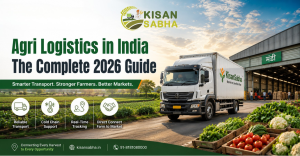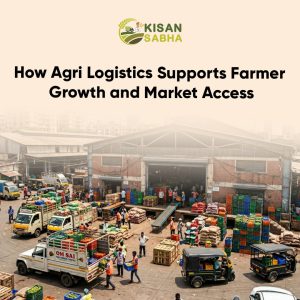

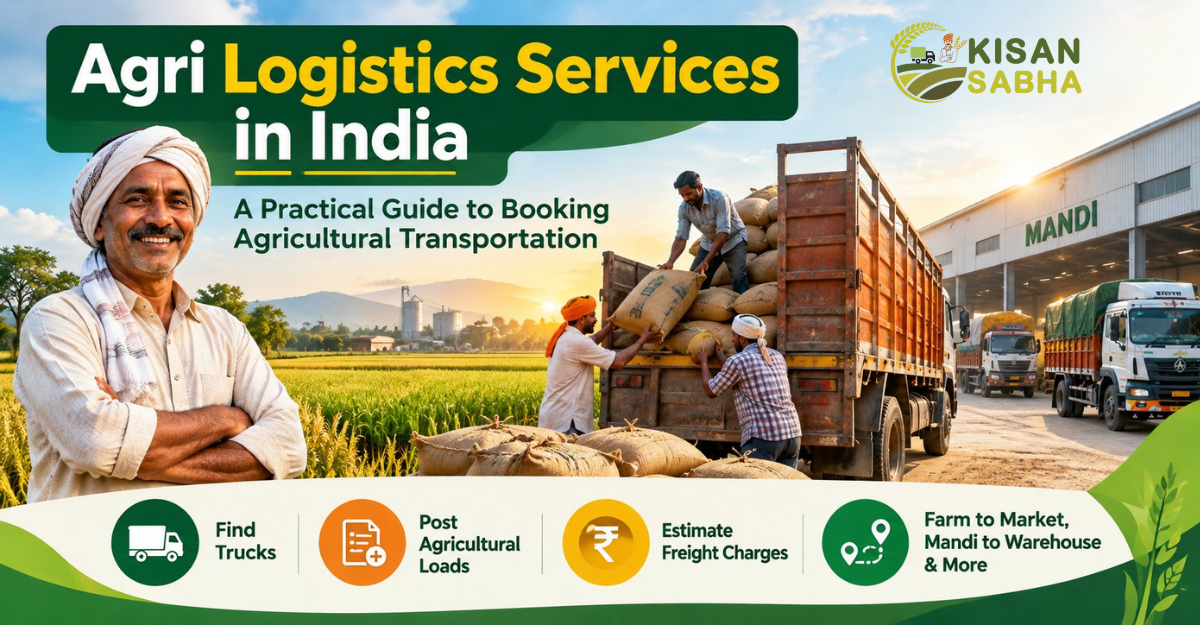
Need a truck to transport wheat, rice, vegetables or other agricultural produce? Finding the right vehicle, comparing transportation charges and arranging timely delivery can be challenging for farmers, mandi traders and agricultural businesses.
During harvesting seasons, transportation becomes even more important. Delayed vehicle arrangements, unclear freight charges and limited transporter options can make it difficult to move agricultural goods from farms to mandis, warehouses and buyers.
This is where Agri Logistics Services in India can make a difference.
Digital agricultural logistics platforms help farmers, Farmer Producer Organizations (FPOs), mandi dealers and transporters coordinate transportation requirements, explore available trucks, post agricultural loads and estimate freight costs.
With KisanSabha, users can explore digital transportation facilities designed to connect farmers, transporters, mandi dealers and agricultural businesses.
In this guide, you will learn how agricultural transportation works, how to book a truck for farm produce, how to calculate freight charges and how to find suitable transportation options through KisanSabha.
What Are Agri Logistics Services?
Agri Logistics Services refer to the transportation, handling, storage and distribution of agricultural products from farms to mandis, warehouses, processing facilities, retailers and buyers.
These services help manage the movement of agricultural commodities throughout the supply chain.
Depending on the business requirement, agricultural logistics may include:
- Farm-to-market transportation.
- Mandi-to-warehouse transportation.
- Warehouse-to-buyer delivery.
- Local and long-distance truck transportation.
- Agricultural load posting and truck matching.
- Freight estimation and transportation planning.
- Shipment tracking and delivery coordination.
- Cold-chain transportation for temperature-sensitive produce.
For example, a farmer harvesting 100 quintals of wheat may need a truck to transport the produce to a nearby mandi or warehouse. Similarly, a vegetable trader may require a suitable vehicle to deliver fresh produce to another city.
The right transportation arrangement depends on the commodity, quantity, vehicle capacity, route and delivery schedule.
Who Needs Agricultural Transportation Services in India?
Agricultural transportation is required by different participants in the farming and supply chain ecosystem.
1. Farmers
Farmers need trucks to transport harvested crops from their farms to mandis, warehouses, collection centres and buyers.
Finding a suitable vehicle at the right time helps them organize crop transportation and plan deliveries.
2. Farmer Producer Organizations (FPOs)
FPOs coordinate agricultural activities for groups of farmers.
They may need multiple trucks to transport bulk agricultural produce from different collection points to mandis, processing facilities or warehouses.
3. Mandi Dealers and Traders
Mandi dealers regularly purchase and sell agricultural commodities such as wheat, rice, pulses, fruits and vegetables.
They require transportation to move goods between mandis, storage facilities and wholesale markets.
4. Agricultural Wholesalers and Buyers
Wholesalers and buyers need reliable transportation to collect agricultural products from different locations and deliver them to their business destinations.
Vehicle availability, freight charges and delivery schedules are important considerations.
5. Transporters and Truck Owners
Transporters also play an important role in agricultural logistics.
They need regular transportation loads to keep their vehicles operational. Digital load-posting and truck-matching facilities can help them discover agricultural transportation requirements and explore return-load opportunities.
Types of Agricultural Transportation Services
Different agricultural commodities require different transportation arrangements.
Here are some common types of agricultural transportation services.
1. Farm-to-Market Transportation
Farm-to-market transportation involves moving agricultural produce directly from farms or collection centres to mandis, wholesale markets and buyers.
It is particularly important during harvesting seasons when large quantities of crops need to be transported.
Before booking a truck, confirm:
- Agricultural commodity and quantity.
- Pickup location.
- Destination mandi or buyer location.
- Required truck capacity.
- Loading arrangements.
- Dispatch and delivery schedule.
2. Mandi-to-Warehouse Transportation
Mandi dealers and traders often need trucks to move purchased commodities to warehouses or godowns.
Proper transportation planning helps coordinate loading, unloading and storage arrangements.
3. Warehouse-to-Buyer Transportation
Agricultural products stored in warehouses may need to reach wholesalers, retailers, processors and other buyers.
The vehicle should have sufficient capacity and be suitable for the type of material being transported.
4. Local Agricultural Transportation
Local transportation covers shorter distances between farms, nearby mandis, warehouses and agricultural businesses.
It is useful for farmers and small traders who regularly move agricultural goods within their regions.
5. Long-Distance Agricultural Transportation
Some agricultural commodities need to be transported between different cities and states.
Long-distance transportation requires proper planning around vehicle suitability, freight expenses, route conditions, transit time and handling requirements.
For perishable goods, packaging and temperature requirements should also be considered.
How to Book a Truck for Agricultural Produce in India
Finding the right truck is one of the most important steps in agricultural transportation.
Traditionally, farmers and traders contact local transporters, brokers or truck owners individually. However, digital platforms offer another way to share transportation requirements and discover potential transporter connections.
Here is how you can organize an agricultural truck booking.
Step 1: Prepare Your Agricultural Load Details
Before searching for a truck, collect the necessary shipment information.
You should know:
- Pickup city or location.
- Destination city.
- Type of agricultural material.
- Total weight or quantity.
- Required truck type.
- Number of trucks required.
- Scheduled loading date.
Providing accurate information helps transporters understand your transportation requirements.
Step 2: Choose the Right Truck Type
Different agricultural commodities require different vehicle capacities and handling arrangements.
For example:
| Agricultural material | Transportation consideration |
| Wheat and rice | Suitable payload and moisture protection |
| Potatoes and onions | Ventilation and careful stacking |
| Tomatoes and fruits | Careful handling and suitable packaging |
| Pulses and seeds | Protection from moisture and contamination |
| Perishable commodities | Temperature requirements and transit time |
Select a vehicle according to the actual shipment requirements rather than choosing only on the basis of availability.
Step 3: Post Your Load Online
Digital load-posting platforms allow farmers and agricultural businesses to share their transportation requirements.
On KisanSabha, users can enter details such as:
- Source and destination cities.
- Agricultural material.
- Weight of the shipment.
- Truck type.
- Number of trucks.
- Scheduled loading date.
Users can also provide additional shipment instructions.
Explore: Post Your Agricultural Load on KisanSabha
Step 4: Compare Transportation Quotations
Before confirming a truck, compare available freight quotations and transportation terms.
Consider the total transportation cost, vehicle capacity, pickup schedule, delivery expectations and additional charges.
Step 5: Verify Transporter and Vehicle Details
Before finalizing the arrangement, check the available transporter information, vehicle registration, driver’s details and relevant documents.
Also clarify the agreed freight and payment terms.
Step 6: Confirm the Booking
Once the transportation terms are agreed upon, confirm the vehicle, pickup date, loading arrangements, payment conditions and expected delivery schedule.
Keeping written records of the agreed details can help avoid misunderstandings.
Full Truck Load vs Part Truck Load: Which Is Better for Agricultural Produce?
Not every farmer or trader needs an entire truck.
The quantity of agricultural produce can help determine whether full truck load or part truck load transportation is more suitable.
Full Truck Load (FTL)
Full Truck Load is suitable when you have a larger quantity of agricultural goods that requires dedicated truck space.
For example:
- Bulk wheat transportation.
- Paddy and rice shipments.
- Large onion consignments.
- Bulk agricultural commodity deliveries.
Part Truck Load (PTL)
Part Truck Load is useful when the shipment quantity is smaller and does not require the entire truck.
For example:
- Small quantities of pulses.
- Packaged agricultural products.
- Smaller vegetable consignments.
- Agricultural supplies.
The right option depends on shipment weight, available truck space, delivery requirements and freight arrangements.
KisanSabha provides separate facilities for Full Load Posting and Part Load Posting.
How to Calculate Agricultural Transportation Costs
Freight charges are an important part of agricultural business expenses.
Before booking a truck, farmers and traders should understand the factors that influence transportation costs.
| Cost factor | How it affects freight |
| Distance | Longer routes generally involve higher transportation expenses |
| Truck type | Different vehicles have different operating costs |
| Load weight | Cargo quantity influences vehicle selection |
| Commodity type | Special handling requirements may affect costs |
| Toll charges | Route-specific tolls add to transportation expenses |
| Loading and unloading | Labour and handling may be charged separately |
| Waiting time | Delays may result in additional expenses |
For example, if you want to transport 100 quintals of wheat from one city to another, the freight estimate will depend on the route, suitable truck capacity and other shipment requirements.
Use an Online Freight Calculator
Instead of estimating transportation expenses without sufficient information, you can use an online freight calculator.
The KisanSabha Freight Calculator allows users to enter:
- Source city.
- Destination city.
- Agricultural material.
- Weight.
- Truck type.
The calculator provides an expected freight estimate that can help with transportation planning.
Remember that an estimated freight amount is not a guaranteed final quotation. Confirm the actual charges, tolls, loading expenses and payment conditions with the transporter before booking.
How to Find the Right Transporter for Agricultural Goods
Choosing a transporter should involve more than comparing the lowest freight quotation.
The vehicle and transportation arrangement should meet your shipment requirements.
Use this checklist before confirming a booking:
1. Check vehicle suitability: Make sure the truck has sufficient capacity and is appropriate for the agricultural commodity.
2. Confirm pickup timing: Discuss when the truck will arrive and whether loading arrangements are ready.
3. Compare total freight: Check whether tolls, loading, unloading and waiting charges are included.
4. Verify transporter details: Review available contact information, vehicle documents and driver details.
5. Discuss delivery expectations: Confirm the destination, expected arrival and unloading arrangements.
6. Agree on payment terms: Clarify advance payments, remaining payments and other commercial conditions.
7. Maintain shipment records: Keep the quotation, vehicle details, agreed freight and delivery information.
These steps can help reduce avoidable transportation misunderstandings.
Common Agricultural Transportation Problems and Their Solutions
Farmers, traders and transporters may face different challenges while arranging agricultural transportation.
| Common problem | Practical solution |
| Difficulty finding trucks | Explore digital transporter networks and load boards |
| Unclear freight charges | Use freight estimates and compare quotations |
| Last-minute vehicle arrangements | Post transportation requirements in advance |
| Wrong vehicle selection | Match truck capacity with the commodity |
| Empty return journeys | Explore suitable return-load opportunities |
| Delivery coordination issues | Confirm pickup and unloading schedules |
| Limited shipment visibility | Explore available tracking facilities |
Better coordination between farmers, buyers and transporters can make agricultural goods movement easier to organize.
How KisanSabha Supports Agri Logistics Services in India
KisanSabha provides a digital agricultural platform connecting farmers, transporters, mandi dealers, buyers and agricultural service providers.
Its Agri Logistics service focuses on making agricultural transportation requirements easier to coordinate through digital facilities.
Here is how different users can explore the platform.
For Farmers: Find Transportation Options for Agricultural Produce
Farmers can share their transportation requirements and explore transporter connections for moving agricultural produce.
Whether you need to transport crops from a farm to a mandi, a market to a warehouse or a warehouse to a buyer, you can use the platform to explore relevant transportation options.
For Transporters: Discover Agricultural Load Opportunities
Truck owners and transporters can explore agricultural load requirements and connect with potential customers.
Information such as source, destination, material, weight and truck type helps them evaluate transportation opportunities.
For Mandi Dealers and Buyers: Organize Goods Movement
Mandi dealers and buyers regularly require transportation to move commodities between farms, markets, warehouses and business locations.
KisanSabha provides digital facilities to help connect these agricultural stakeholders with transportation requirements.
Freight Estimation for Better Planning
Freight estimation helps users understand expected transportation expenses before discussing the final quotation.
The KisanSabha Freight Calculator provides an additional reference for planning agricultural transportation.
Local and Long-Distance Transportation Connections
KisanSabha’s Agri Logistics service describes transportation coverage for:
- Farm-to-market movement.
- Market-to-warehouse transportation.
- Warehouse-to-store delivery.
- Local agricultural deliveries.
- Cross-country transportation.
The platform also lists facilities such as truck booking, load matching and shipment tracking. Users should confirm the applicable features, availability and booking terms before arranging transportation.
Explore the service: KisanSabha Agri Logistics
Benefits of Using a Digital Agri Logistics Platform
Digital agricultural logistics platforms can help different participants coordinate transportation requirements more systematically.
For Farmers
- Discover transportation options.
- Share crop transportation requirements.
- Compare available freight quotations.
- Plan farm-to-market movement.
For FPOs
- Coordinate bulk transportation requirements.
- Organize multiple vehicle requirements.
- Plan agricultural collection and delivery.
For Mandi Dealers and Buyers
- Connect transportation with market operations.
- Coordinate warehouse and buyer deliveries.
- Plan commodity movement between locations.
For Transporters
- Discover agricultural load requirements.
- Explore suitable return-load opportunities.
- Connect with potential agricultural customers.
- Improve vehicle utilization through better load matching.
The actual benefits depend on location, vehicle availability, commercial terms and individual shipment requirements.
Frequently Asked Questions About Agri Logistics Services
1. What are agri logistics services in India?
Agri logistics services include the transportation, storage, handling and distribution of agricultural products from farms to mandis, warehouses, processing facilities and buyers.
2. How can I book a truck for agricultural produce?
Prepare your pickup location, destination, commodity, weight, truck type and loading date. You can then post your load through a digital transportation platform such as KisanSabha and explore transporter connections. Compare quotations and confirm the booking terms before dispatch.
3. How can farmers find transporters for agricultural goods?
Farmers can contact local transporters or use digital load-posting platforms to share their transportation requirements and discover potential transporter connections.
4. How can I calculate agricultural transportation charges?
Transportation charges depend on distance, truck type, load weight, commodity, tolls and handling expenses. You can use the KisanSabha Freight Calculator to estimate transportation costs before finalizing the freight.
5. What types of agricultural goods can be transported?
Common agricultural commodities include wheat, rice, pulses, seeds, fruits, vegetables, spices, potatoes, onions and other agricultural products. Vehicle selection depends on quantity, packaging and handling requirements.
6. What is the difference between full truck load and part truck load?
Full Truck Load (FTL) uses dedicated truck space for a larger shipment, whereas Part Truck Load (PTL) is suitable for smaller shipments that do not require the entire vehicle.
7. Can transporters find agricultural loads online?
Yes. Digital load boards allow transporters to explore posted transportation requirements and connect with potential customers. KisanSabha provides load-related facilities for this purpose.
8. Does agri logistics include warehouse transportation?
Yes. Agricultural logistics includes transportation from farms to warehouses, mandis to warehouses and warehouses to buyers, depending on the supply chain requirements.
Arrange Agricultural Transportation Through KisanSabha
Finding a suitable truck, understanding freight charges and coordinating timely deliveries are important parts of agricultural business operations.
Whether you are a farmer transporting harvested crops, an FPO arranging bulk movement, a mandi dealer managing inventory or a transporter looking for agricultural loads, organized transportation planning can help make your operations easier to manage.
KisanSabha brings agricultural stakeholders together through its digital platform and offers transportation-related facilities for farm-to-market, market-to-warehouse, warehouse-to-store, local and cross-country movement.
Looking for Agri Logistics Services in India? Explore KisanSabha to post agricultural loads, discover transportation options and estimate freight charges.
Explore Agri Logistics: https://kisansabha.in/Agri-Logistics.aspx
Post Your Load: https://kisansabha.in/LoadPosting.aspx
Calculate Freight: https://kisansabha.in/FreightCalculator.aspx
Website: https://kisansabha.in/
Contact: +91 8181-08-00-00
Email: info@kisansabha.in