
Ask a farmer why they accepted a lower price than expected, and the answer is rarely “the crop wasn’t good enough.” More often, they simply didn’t know what the crop was worth elsewhere, or they had only one buyer to sell to that day. This is the exact gap mandi startups are built to close. Here’s a clear, practical look at how mandi startups help farmers get better prices for their crops – not as a marketing promise, but as a set of specific mechanisms that change the economics of a sale.
The Real Reason Farmers Get Underpaid
Before looking at the fix, it helps to name the problem precisely. Farmers typically lose value at three points in the traditional trade chain:
- Information gaps. Farmers rarely know the current mandi rate in nearby or distant markets before they sell.
- Limited buyer access. They deal with whichever trader shows up locally that day, with no real alternative to compare against.
- Layers of middlemen. Each intermediary between the farm and the final buyer takes a commission before the price reaches the farmer.
None of this is about crop quality. These are structural weaknesses in how the trade chain is organized, built up over decades of farmers having no practical way to check prices beyond the mandi gate. And structural problems need structural fixes -which is exactly what a digital mandi platform is designed to provide.
1. Price Transparency Through Daily Mandi Rate Data
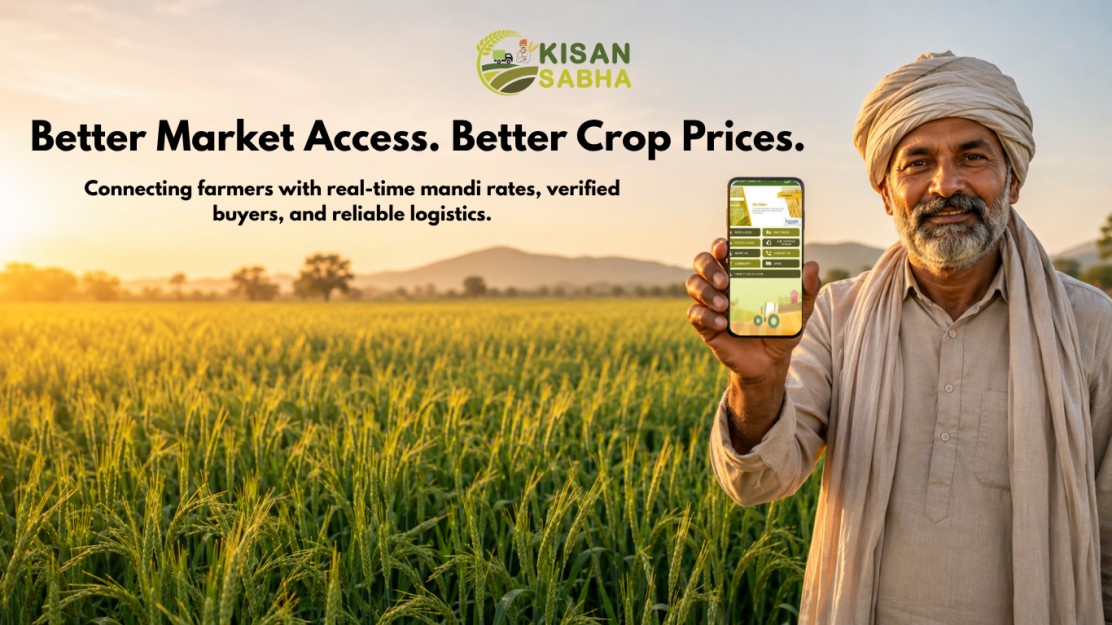
The single biggest lever a mandi startup pulls is information. Platforms like KisanSabha publish daily price updates from major mandis across India. A farmer can check what wheat, cotton, or vegetables are selling for in several markets, not just the nearest one. When a farmer knows the going rate before a conversation with a buyer even starts, the negotiation shifts in their favor. This one change – price transparency -is often the most direct answer to how mandi startups help farmers get better prices.
Traditionally, price information flowed one way: from trader to farmer, on the trader’s terms. A digital mandi rate feed reverses that flow. The farmer walks into the conversation already knowing the benchmark, which makes it much harder for a buyer to lowball an offer and count on the farmer simply not knowing better.
There’s a second, less obvious benefit here too. Price transparency doesn’t just help in the moment of sale – it helps farmers plan ahead. A farmer who checks mandi rates regularly through the season starts to understand demand patterns: which weeks tend to see higher prices, which crops are trending up, and where regional gaps exist. That kind of pattern recognition used to be something only large traders had access to. Now it’s available on a phone.
2. Access to a Wider Pool of Buyers
A traditional mandi limits a farmer to whichever traders are physically present that day. A mandi startup removes that ceiling entirely. A dealer in Gujarat can buy from a farmer in Madhya Pradesh. A buyer in Punjab can source crops from Maharashtra. More buyers competing for the same produce naturally pushes prices up – this is basic market economics, made possible only because the platform connects farmers to a much larger network than geography alone would ever allow.
This matters most for farmers growing crops with strong demand in specific regions. A grower producing a specialty pulse or an export-quality spice might find their best buyer isn’t the trader down the road at all, but a dealer three states away who’s willing to pay more for exactly that crop. Without a digital platform, that buyer and that farmer would likely never even know the other existed.
Wider buyer access also changes the farmer’s negotiating posture in a subtle but important way. When a farmer has only one potential buyer, the buyer holds nearly all the leverage – the farmer either accepts the price offered or doesn’t sell at all. When a farmer can compare offers from several dealers, the dynamic flips. The farmer can walk away from a weak offer, knowing there’s a realistic alternative. That single shift in leverage is often worth more than any individual price negotiation tactic.
3. Fewer Middlemen Between Farm and Buyer
Every additional layer in the traditional supply chain adds a commission. That cost rarely disappears – it’s usually absorbed by the farmer, quietly, through a lower quoted price. Mandi startups let farmers connect directly with dealers and transporters on one platform, removing several of these layers at once. The savings don’t vanish; they land back with the farmer, either as a higher price for the crop or a lower cost of getting it to market.
This is also where the trust question comes in. Cutting out a middleman only helps if the direct connection is still reliable. In the traditional system, the middleman wasn’t just adding cost -they were also providing a service: vouching for the buyer, handling disputes, and making sure payment actually happened. Simply removing that layer without replacing its function would leave farmers more exposed, not less.
That’s why platforms with verified dealer profiles, transaction history, and dispute resolution support matter so much. They replace the trust a middleman used to provide, without the commission attached to it. A farmer dealing directly with a verified dealer on a platform gets the same basic assurance -this buyer is legitimate, payment is tracked, disputes have a resolution path – without paying someone else to guarantee it.
4. Better Timing Decisions
Crop prices fluctuate through a season, sometimes significantly. Without market data, farmers often sell as soon as the harvest is ready, simply because that’s when a trader happens to show up. With access to price trends and demand forecasts, farmers can make a more deliberate call on when to sell, rather than reacting to whoever is standing in front of them.
Over a full season, this timing advantage can meaningfully change what a harvest earns. Selling two weeks earlier or later based on actual price movement – instead of convenience – is a decision farmers simply couldn’t make confidently without visibility into the wider market. This is especially relevant for crops that don’t spoil quickly, where a farmer genuinely has the option to hold and wait for a better price window rather than being forced into an immediate sale.
Timing decisions also connect back to buyer access. A farmer watching prices rise in a neighboring state can use that same platform to find a buyer there before the price moves again – something that would have been logistically impossible to act on quickly using only word-of-mouth or a single local mandi visit.
5. Reliable Logistics That Protect the Price Already Agreed
A good price negotiated is not the same as a good price received. Spoilage, delays, or damage during transport can quietly erode the value of a deal after it’s already made – a problem that has nothing to do with the negotiation itself and everything to do with what happens after. Mandi startups that connect farmers with verified transporters help protect the agreed price by making sure the crop actually arrives in sellable condition, on time.
This is a quieter part of the story, but it’s just as important as the pricing mechanisms above. A 10% better price negotiated is meaningless if 15% of the load is lost or downgraded in transit. Reliable logistics is what turns a good negotiated price into an actual good outcome at the end of the transaction – and it’s a piece that’s easy to overlook when discussing “better prices” purely as a negotiation topic.
Tracking also plays a role here. Being able to see where a shipment is, rather than simply hoping it arrives, reduces the uncertainty that used to make farmers hesitant to sell to buyers outside their immediate area in the first place.
Putting It Together: What This Looks Like in Practice
On a platform like KisanSabha, a farmer growing pulses in Madhya Pradesh can check today’s mandi rate for pulses across several states, message multiple dealers directly, agree on a price with whoever offers the best deal, book a verified transporter through the same app, and receive payment through a secure, trackable system – all without a single middleman controlling the outcome. That combination of transparency, wider reach, and reduced intermediation is the practical mechanism behind better crop prices. It isn’t a slogan; it’s five separate, compounding advantages working together, each addressing a specific weakness in the traditional trade chain.
It’s worth noting that these five mechanisms don’t work in isolation -they reinforce each other. Price transparency is more useful when there are multiple buyers to actually negotiate with. Wider buyer access is safer when trust and verification systems are in place. Better timing only matters if logistics can reliably get the crop to a buyer three states away instead of just the nearest one. The value of a mandi startup comes from all five working together, not from any single feature on its own.
Frequently Asked Questions
Both, but the price advantage is the more significant one. Convenience matters, but the real gain comes from KisanSabha giving farmers better price information and access to a wider set of dealers – conditions that simply don’t exist at a single local mandi on a given day.
Yes, KisanSabha offers free basic registration for farmers to list their produce and connect with dealers, with optional paid packages available for added features like premium visibility or priority support.
Crops with regional price variation or specialty demand – pulses, spices, cotton, and certain fruits and vegetables – tend to see the biggest benefit on KisanSabha, since its pan-India dealer network can surface a much better offer than what’s available locally.
Not necessarily. Many transactions on KisanSabha – including price discussion, transport booking, and payment – can be completed entirely through the platform. Some farmers still use their local mandi for very small or urgent sales alongside KisanSabha.
KisanSabha uses registration verification, transaction history, and dispute resolution support to build trust between farmers, dealers, and transporters who may never meet in person before completing a deal.
Final Thoughts
Better prices for farmers don’t come from one feature – they come from removing the structural disadvantages that have shaped mandi trade for decades: limited information, limited buyers, and too many hands in between. Mandi startups address all three at once, which is why platforms like KisanSabha are increasingly seen as a practical complement to, not a replacement for, the local mandi. The technology doesn’t change what farmers grow. It changes what they’re able to know, who they’re able to reach, and how much of the final price actually reaches their pocket.
Want to see today’s mandi rates and connect with buyers directly? Register free on KisanSabha and start comparing prices before your next sale.