
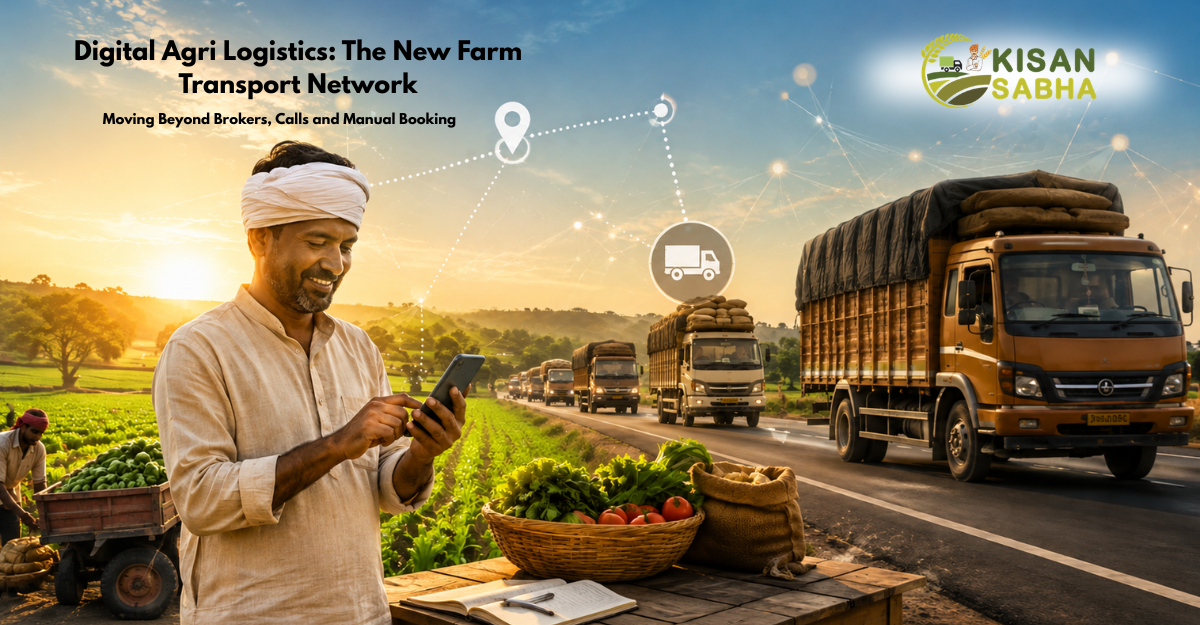
For decades, agri logistics in India ran on a chain of phone calls -a farmer calling a local broker, the broker calling a few truck owners, and everyone hoping a truck showed up on time. Today, digital agri logistics platforms like KisanSabha have replaced that chain with an app: post a load, get instant quotes from verified transporters, track the truck live, and pay securely – all from a phone.
The Old Way: A Chain of Phone Calls in Farm Transport
Ask any farmer over 40 how they used to book a truck, and the answer is almost always the same: through someone they knew. A local commission agent or broker kept a mental list of truck owners in the area. When a farmer needed to move produce, the process looked something like this:
- Call the local broker and describe the load.
- The broker calls two or three truck owners he trusts.
- Wait – sometimes hours, sometimes a full day -for someone to confirm availability.
- Negotiate a price with no real reference point for what’s “fair.”
- Hope the truck shows up on schedule, in the right condition, for the right crop.
This system worked, but it worked slowly and unevenly. A broker’s network was only as big as his phonebook. If none of his contacts had a free truck during peak harvest, the farmer either waited or paid a premium to a stranger. There was no way to compare prices across multiple transporters at once, no tracking once the truck left, and payment was almost always settled in cash, informally, after delivery -leaving room for disputes on both sides.
Why the Old Agri Logistics System Struggled to Scale
The phone-call model wasn’t broken because people were doing a bad job – it was broken because it wasn’t built to handle India’s scale. The country has millions of small and marginal farmers, tens of thousands of mandis, and a truck fleet spread across every district. A single broker’s contact list simply couldn’t represent that entire network.
This created three consistent problems:
- Information stayed local. A transporter with a free truck in a neighboring district had no way of knowing a farmer 50 kilometers away needed one.
- Prices stayed opaque. Without a shared reference rate, farmers had no easy way to know if a quoted price was fair.
- Trust had to be rebuilt every time. Every new transaction with an unfamiliar transporter started from zero trust, slowing everything down.
What Made the Shift Possible
The move from phone calls to apps didn’t happen in isolation – it rode on three broader changes across rural India. First, affordable smartphones reached even small towns and villages, putting a data connection in the hands of farmers who previously had none. Second, cheaper mobile internet plans meant that data-heavy activities like posting a load with photos, or tracking a live shipment, became affordable for daily use, not just a luxury. Third, the rise of UPI and other digital payment systems gave farmers and transporters a fast, low-cost way to settle freight charges without depending on cash or bank visits. Together, these three shifts created the conditions for agri logistics platforms to work at scale – the technology existed earlier, but the infrastructure to support it at the grassroots level only caught up in the last several years.
The Shift: What Changed When Farm Transport Went Digital
The move to digital agri logistics didn’t happen overnight – it followed the same path as ride-hailing and food delivery: replace a manual, local network with a searchable, verified, app-based one. On a platform like KisanSabha, the same five-step phone-call process now looks like this:
- Post the load online – source, destination, material, weight, and truck type, using tools like the Load Board.
- Receive multiple quotes within minutes from verified transporters across a much wider network than any single broker could offer, via the Truck Board.
- Compare prices instantly using a freight calculator and distance calculator, which give a transparent, market-based reference rate.
- Track the shipment in real time, so no one is left wondering where the truck is.
- Pay through a secure digital system, removing the friction and disputes that came with informal cash settlements.
The core shift isn’t just “phone to app” – it’s local to networked, and opaque to transparent. A farmer in one district can now be matched with a transporter in another who happens to be dropping off a load nearby and would otherwise be driving back empty.
What Digital Agri Logistics Fixes That Phone Calls Couldn’t
Wider reach, instantly. A digital load board isn’t limited by how many numbers are saved in someone’s phone. It pulls from a verified network of transporters across regions, so farmers aren’t stuck with whoever the local broker happens to know.
Fewer empty return trips. One of the biggest inefficiencies in trucking is a vehicle driving back empty after a delivery. Smart load matching connects transporters with return loads along their route, which lowers costs for everyone – a coordination problem that was nearly impossible to solve over the phone.
Real price transparency. Instead of a single quoted number with no context, farmers and dealers can see calculated freight estimates based on distance, weight, and vehicle type before they negotiate anything.
Verified, specialized transport. Directories of transporters and agricultural service providers -including cold storage and GPS-equipped vehicles – mean perishables get matched to the right kind of truck, not just whichever one was available.
A paper and payment trail. Digital booking naturally creates a record – of the quote, the booking, and the payment -something that informal, verbal deals never had.
Who Gains the Most From This Shift?
Farmers get more transporter options, competitive pricing, and vehicles suited to their specific crop, all without relying on a single broker’s availability.
Transporters get more consistent access to loads year-round, fewer empty return trips, and faster, more transparent payments – plus ratings that help reliable operators stand out.
Mandi dealers and buyers get predictable delivery timelines and a direct line to farmers and transporters, cutting out layers of intermediaries that added cost without adding value.
Frequently Asked Questions
Farmers typically relied on local brokers or commission agents who maintained personal contacts with a small number of truck owners. Booking depended entirely on that broker’s network and availability, often taking hours or days to confirm.
Apps like KisanSabha replaced the local, phone-based network with a digital one. Farmers can post load requirements online and receive multiple quotes from verified transporters within minutes, instead of waiting on a broker to make calls.
No. Digital load boards give small and marginal farmers access to the same wide transporter network and transparent pricing that was previously easier for large-scale traders to arrange through personal connections.
Not entirely – local expertise about roads, seasons, and crop handling still matters. What digital platforms remove is the bottleneck of relying on one person’s phonebook to find a truck.
Once a shipment is booked, the platform provides real-time or scheduled status updates so farmers and buyers can monitor where the truck is, rather than calling the driver directly for updates.
The Bottom Line
The shift from phone calls to apps in farm transport isn’t just a technology upgrade – it’s a structural fix for a system that was always limited by the size of a broker’s contact list. Platforms like KisanSabha turn agri logistics into a searchable, transparent, and trackable process, giving farmers, transporters, and dealers a faster, fairer way to move produce from field to market.
Ready to move your load? Post your load now or find a truck near you on KisanSabha.