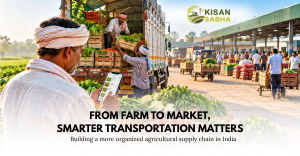

A farmer has a good lot of produce ready. The local trader names a rate and calls it the going price. Is it? Are there other buyers within reach? Is today the right day to sell? Without answers, many farmers accept the first offer.
Digital agri marketplaces try to close that information gap. They put listings, buyers, mandi rates, and transport options in one place, usually on a mobile app, so farmers can sell crops online and compare offers. This guide explains how they work, what they cannot do, and how to use one safely.
Quick answer: A digital agri marketplace is an online platform, usually a website or mobile app, where farmers list produce and buyers find it, compare rate,s and agree on a deal. It can widen buyer reach and improve price visibility. It cannot guarantee a better price, because quality, quantity, timi,ng and location still decide the final rate.
What Is a Digital Agri Marketplace in India?
A digital agri marketplace is an online platform where farmers list produce and buyers find it, compare rates, and agree on a deal.
Buyers may be traders, mandi dealers, food processors, retailers or individual consumers. Some platforms, also called online agricultural marketplaces, add inputs such as seed and fertiliser, plus services like storage and transport.
For most farmers, the app works alongside the mandi, not instead of it. A farmer may check rates or find an extra buyer online, and still sell in the mandi when that is the better choice.
Why Do Farmers Struggle to Get the Right Price?
Because they often have few buyers to choose from, limited price informatio,n and little time to wait.
- Few buyers within reach. In many villages, one or two traders decide the offer.
- Price information gap. Rates differ between mandis and change daily.
- Timing pressure. Perishable crops cannot wait, and grain growers may need cash for the next season.
- Transport and storage. Without a truck or godown, the farmer sells locally at whatever rate is offered.
- Quality disputes. If the grade is not agreed in advance, the price can drop at delivery.
A marketplace helps directly with the first two problems and partly with the rest.
How Do Farmers Sell Crops Online on a Digital Agri Marketplace?
The farmer registers, lists the crop, receives buyer enquiries, agrees on terms, then arranges delivery and payment.
- Register. Sign up with a mobile number and basic details.
- List the crop. Add crop name, quantity, grade, expected date and location. Photos help.
- Receive enquiries. Interested buyers contact the seller or make an offer.
- Compare and agree. Check rates, ask questions and settle price, grade and payment terms.
- Arrange transport. Book a truck or confirm the buyer’s pickup.
- Deliver and get paid. The buyer checks the produce and payment follows as agreed.
Platforms differ in how much they handle. Some only connect people. Others also help with transport or payment. Read what your platform actually does before you depend on it.
How Can a Marketplace Help Farmers Find the Right Buyer?
By showing the listing to more buyers than a farmer could reach through phone calls and personal visits.
A buyer in another district may need exactly your crop and grade. Search by crop, quantity and location makes that match easier. Buy leads also show what buyers want before harvest, so a farmer can plan timing and quantity.
The right buyer is not always the highest bidder. Look at the buyer’s payment record, ability to collect the produce and fit with your quality. A slightly lower rate from a reliable buyer can beat a higher promise that falls through.
How Can It Help Farmers See a Fair Price?
By showing current mandi rates and several offers side by side, so the farmer can compare before deciding.
A fair comparison needs the same crop, the same grade and the same day. Check the date and mandi name beside every rate. A rate from last week, or from a market 300 km away, says little about today’s offer.
Where the government announces a minimum support price (MSP), it is a useful reference point. Our guide to the PM AASHA Scheme 2026 explains MSP support. Remember that app rates are indicative. The final price still depends on quality, quantity, moisture, timing and transport cost.
What Is e-NAM and How Is It Different From Private Marketplaces?
e-NAM is the government’s National Agriculture Market, an electronic platform that connects existing mandis. Private agri marketplaces are run by companies and startups on their own terms.
e-NAM was launched in April 2016. According to the Press Information Bureau (PIB), 1,656 mandis were integrated as of June 2026, with 1.89 crore farmers and 2.78 lakh traders registered. By March 2026, 4,724 Farmer Producer Organisations (FPOs) were registered, and cumulative trade since 2016 stood at 13.25 crore metric tonnes, worth ₹4.84 lakh crore. The e-NAM app gives mobile price information for 247 commodities.
| Point | e-NAM | Private agri marketplace |
| Run by | Government of India | Companies and startups |
| How it works | Connects existing mandis into one online platform | Listings, enquiries and direct deals, as the platform designs them |
| Who registers | Farmers, traders, FPOs | Sellers, buyers, service providers |
| Payment | Sale proceeds go to the farmer’s registered bank account after the trade | Varies by platform, so check the terms |
| Coverage | 1,656 mandis in 23 States and 4 UTs | Depends on the platform and region |
PIB also reports more than 10.31 crore Farmer IDs created under the Digital Agriculture Mission as of 3 August 2026. Our post on Farmer IDs explains why they matter.
What to recheck: These figures are updated regularly. Check the latest PIB release or the official e-NAM portal before you quote a number.
What Features Should a Farmers Marketplace App Have?
A good app makes listing easy, shows clear prices, supports your language and helps you check who you are dealing with.
- Simple listing with crop, quantity, grade, photos and location
- Local language support and an easy layout
- Dated mandi rates linked to a named market
- Chat or negotiation with buyers
- Profile details or ratings for buyers and sellers
- Help with transport and storage
- A helpline or support contact
- Clear fees, shown before you commit
No single app has to do everything. What matters is that the features you need are reliable.
Who Else Benefits From Online Agri Marketplaces?
Small farmers, FPOs, buyers and transporters can all gain, in different ways.
- Small and marginal farmers can reach buyers beyond the village, though minimum lot sizes may apply.
- FPOs can pool produce from members and offer buyers a larger lot.
- Buyers and processors can search by crop and grade instead of calling contacts one by one.
- Transporters can find loads that match their route and fill return trips.
The common benefit is better records. Enquiries, rates and agreements stay in one place, which helps when a dispute needs sorting out.
What Happens After the Deal? Transport and Storage
After the price is agreed, the produce must reach the buyer on time and in good condition, so transport and storage decide how much of the deal you keep.
A late truck or a wrong vehicle can cost more than the gain from a better rate. Use a Freight Calculator to estimate cost, confirm the vehicle type for your crop and agree on pickup time. If the buyer cannot collect immediately, a Warehouse Inquiry can help you find storage.
For more on moving produce, read our guides on farm-to-market transportation and why agricultural transportation needs better organization.
What Are the Limits and Risks of Online Agri Marketplaces?
An online marketplace can connect you with buyers and show information, but it cannot guarantee a price, a buyer or a safe payment.
| Risk | What to check |
| Listing gets no response | Add clear photos, quantity, grade and location, and check enquiries often |
| Buyer asks for a lower price at delivery | Agree the grade and tolerance before dispatch |
| Unclear fees | Ask about listing charges, commission and freight upfront |
| Payment delay | Confirm payment terms and any advance in writing |
| Rates are not comparable | Compare the same grade, the same day and the same mandi |
| App or language difficulty | Look for local language support, or ask an FPO member or family member for help |
New users should start with a small lot. Keep chat records, weighment slips and receipts.
How Can You List Your Crop Safely?
Prepare the details first, verify the buyer and keep a record of every agreement.
- Know your quantity, grade and the earliest date you can deliver.
- Check today’s rate in nearby mandis before you accept any offer.
- Take clear photos of the actual produce, not stock images.
- Look at the buyer’s profile, ratings and past activity.
- Do not pay any fee to receive a payment.
- Agree price, grade, quantity, pickup time and payment date in writing.
- Keep the weighment slip and delivery receipt.
How Does Kisan Sabha’s Agricultural Marketplace Support Farmers?
Kisan Sabha, run by Sarvodaya Infotech Pvt. Ltd., brings farmers, buyers, mandi dealers and transporters onto one platform. Our agricultural marketplace page gives an overview of the service and the Kisan Sabha app.
The platform includes tools for the steps above:
- Sell Leads and Buy Leads to find sellers and buyers.
- Mandi Rate and APMC details to compare market prices.
- The Stakeholders Directory to find farmers, mandi dealers, transporters and service providers.
- Post a Load for transport.
Use these tools as you would any marketplace: compare, ask questions and confirm details before you commit your produce.
Frequently Asked Questions About Digital Agri Marketplaces
A digital agri marketplace is an online platform, usually a website or mobile app, where farmers list produce and buyers find it, compare rates and agree on a deal. Some also offer transport, storage and input supply.
It shows current rates and brings more buyers, so farmers can compare offers before they sell. It does not guarantee a higher price, since quality, quantity and timing still matter.
No. e-NAM is a government platform that connects existing mandis into one online market. Private agri marketplaces are run by companies and work on their own terms.
A smartphone makes it easier, but check what support the platform offers. Some provide phone help, and many farmers get help from FPO staff or family members.
No. e-NAM is a government platform that connects existing mandis into one online market. Private agri marketplaces are run by companies and work on their own terms.
Yes, though minimum lot sizes and service areas vary by platform. Small farmers can also sell together through an FPO to offer a larger lot.
Look at the buyer’s profile, ratings and past activity, and start with a small deal. Never pay a fee to receive payment, and keep a record of every agreement.
Not always. App rates are indicative for a market and a grade. Your price depends on quality, quantity, moisture, timing and transport cost.
According to PIB, over 1.89 crore farmers and 2.78 lakh traders were registered on e-NAM as of June 2026, with 1,656 mandis integrated.
Conclusion
A digital agri marketplace works best when it solves a plain problem: a buyer you cannot find, a rate you cannot see, a truck you cannot book. It gives farmers more choices and better information. It does not replace careful grading, fair terms and good records.
Before you list your crop, check today’s rate, verify the buyer and agree the terms in writing. To explore these tools in one place, visit the Kisan Sabha agricultural marketplace page or register to see how listing and buyer search work.