Introduction
India’s agricultural sector is changing with the growth of digital technology. Farmers, mandi dealers, wholesalers and agricultural businesses are increasingly exploring online platforms to buy and sell agricultural products.
Traditionally, farmers depend on physical mandis, local traders and commission agents to sell their produce. However, finding the right buyers, comparing market prices, arranging transportation and managing payments can still be challenging.
This creates an opportunity for entrepreneurs to build a Digital Mandi Startup in India.
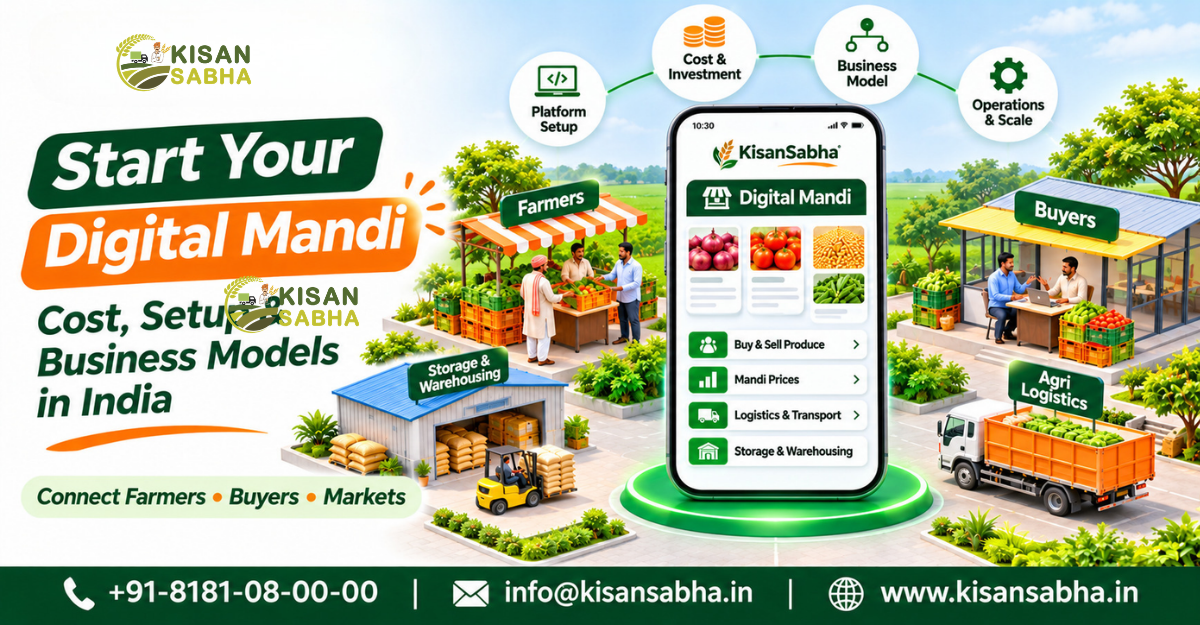
A digital mandi is an online platform that connects farmers, agricultural traders, buyers and other market participants through a website or mobile application. It helps users discover agricultural products, share buying and selling requirements, access market information and explore logistics services.
But starting a digital mandi business requires more than developing an app. You need the right business model, market research, technology, legal compliance, seller and buyer networks, and a sustainable revenue strategy.
In this guide, we explain how to start a digital mandi startup in India, what costs to consider, which business models you can choose, how digital mandis generate revenue and how KisanSabha can help entrepreneurs explore this opportunity through an existing agricultural network.
What Is a Digital Mandi?
A digital mandi is an online agricultural marketplace where farmers, traders, wholesalers and buyers can connect to trade agricultural products.
Unlike a traditional mandi, which operates through a physical market yard, a digital mandi uses websites and mobile applications to make agricultural trading information accessible online.
Depending on its business model, a digital mandi platform may offer:
- Online agricultural product listings.
- Farmer and buyer connections.
- Mandi price information.
- Buying and selling leads.
- Digital communication and negotiation.
- Agricultural transportation services.
- Warehouse and storage connections.
- Payment and transaction management.
A digital mandi does not necessarily replace a traditional mandi. It can also work alongside existing agricultural markets by helping farmers discover additional buyers and giving traders access to wider supply networks.
For entrepreneurs, this creates opportunities to build specialised platforms for particular crops, regions or agricultural services.
Why Is Starting a Digital Mandi Startup a Business Opportunity in India?
Agriculture is one of India’s major economic sectors, but several challenges still affect agricultural trading and distribution.
These challenges create opportunities for technology-driven businesses.
1. Limited Access to Buyers
Farmers in smaller towns and rural areas may have limited access to buyers outside their local markets.
A digital mandi can help connect them with traders, wholesalers and businesses in other locations.
2. Lack of Transparent Market Information
Agricultural prices can vary between mandis, regions and seasons.
Access to relevant market information can help farmers and traders compare prices and make better purchasing decisions.
3. Transportation and Logistics Challenges
Finding suitable trucks, managing freight costs and arranging timely deliveries can be difficult for agricultural businesses.
A digital mandi with logistics connections can help address these transportation requirements.
4. Unorganised Agricultural Trading
Many agricultural transactions still depend on phone calls, personal relationships and informal records.
Digital platforms can help organise product listings, buying requirements and business communication.
5. Growing Demand for Digital Agricultural Services
Farmers and agricultural businesses are exploring digital solutions for product discovery, market information, transportation and supply chain management.
Entrepreneurs can build specialised services around these requirements instead of trying to create a platform that solves every agricultural problem at once.
6 Digital Mandi Business Models You Can Start in India
Before investing in technology, decide how your digital mandi startup will operate and generate revenue.
Different business models require different levels of investment, operational support and market participation.
Here are six business models worth considering.
1. Commission-Based Agricultural Marketplace
This model connects farmers and sellers with buyers through an online platform.
The business earns a commission or transaction fee when a trade is completed, depending on the agreed commercial arrangement.
How it works:
- Farmers or sellers list their agricultural products.
- Buyers explore available products.
- Both parties connect and discuss requirements.
- They agree on price, quantity and delivery.
- The platform earns a fee where applicable.
Revenue opportunity: Commission on completed transactions.
Main challenge: Ensuring that buyers and sellers complete their transactions through the platform.
2. Agricultural Supply Chain and Aggregator Model
In this model, the startup sources agricultural produce from farmers and supplies it to retailers, wholesalers, processors or other businesses.
The company may manage procurement, grading, packaging, storage and transportation.
How it works:
- Source agricultural products from farmers.
- Check quality and quantity.
- Arrange packaging and storage.
- Supply products to business buyers.
- Manage transportation and delivery.
Revenue opportunity: Margin between procurement and selling prices.
Main challenge: This model requires working capital, inventory management and operational infrastructure.
3. Agri Logistics-Based Digital Platform
Transportation is a major part of the agricultural supply chain.
A logistics-led digital mandi connects agricultural buyers, sellers and transporters to arrange product movement.
How it works:
- Buyers or sellers share load requirements.
- Transporters explore available loads.
- Suitable vehicles are selected.
- Freight and delivery conditions are agreed upon.
- Transportation is coordinated.
Revenue opportunity: Freight commissions, booking fees or subscription packages, depending on the business model.
Main challenge: Managing truck availability, route planning and transportation reliability.
4. Mandi Management Software
Instead of creating a marketplace, entrepreneurs can develop software for mandi dealers and agricultural traders.
The software can help businesses manage daily operations and records.
Possible features:
- Inventory management.
- Digital billing.
- Purchase and sales records.
- Customer management.
- Product and price records.
- Business reporting.
Revenue opportunity: Monthly or annual software subscriptions.
Main challenge: Getting traditional mandi businesses to adopt and regularly use the software.
5. Agricultural Leads and Subscription Platform
This model connects buyers and sellers through business leads and membership packages.
Users can explore relevant agricultural opportunities through paid subscriptions or listing services.
Possible services:
- Buyer leads.
- Seller leads.
- Agricultural business listings.
- Promoted product listings.
- Business directory access.
- Subscription-based membership.
Revenue opportunity: Subscription fees, premium listings and lead packages.
Main challenge: Maintaining lead quality and building trust among platform users.
6. Value-Added Agricultural Services
A digital mandi can expand beyond buying and selling by offering additional agricultural services through business partners.
Examples include:
- Warehouse and cold storage connections.
- Product quality testing.
- Agricultural input services.
- Financing partnerships.
- Transportation solutions.
- Insurance-related services.
Revenue opportunity: Service charges, referral fees or partnership revenue, where permitted.
Main challenge: Finding reliable service partners and meeting applicable compliance requirements.
Comparison of Digital Mandi Business Models
| Business model | Revenue source | Investment considerations | Main challenge |
| Commission marketplace | Transaction commission | Technology and onboarding | Trade retention |
| Supply chain aggregator | Trading margin | Working capital and operations | Inventory management |
| Logistics platform | Freight fees and subscriptions | Technology and transporter network | Vehicle availability |
| Mandi software | Subscription | Software development | User adoption |
| Leads platform | Subscriptions and listings | Platform and marketing | Lead quality |
| Value-added services | Service and partner fees | Partnerships and compliance | Service reliability |
Expert tip: Start with one business model that matches your available capital, market knowledge and customer network. You can introduce additional services once your platform starts generating regular demand.
How to Start a Digital Mandi Startup in India: Step-by-Step Guide
Starting a digital mandi business requires careful planning. Follow these steps before investing heavily in technology or operations.
Step 1: Select Your Target Market and Agricultural Products
Do not begin by targeting every farmer, crop and state.
Start with a specific market.
For example:
- Vegetable trading in Uttar Pradesh.
- Fruit supply chains in Maharashtra.
- Grain trading across selected mandis.
- Spice trading in Rajasthan.
- Agricultural logistics for regional traders.
Decide which customers you want to serve first:
- Farmers.
- Mandi dealers.
- Wholesalers.
- Retailers.
- Food processing companies.
- FPOs.
- Agricultural transporters.
A focused target market makes customer acquisition and business development easier.
Step 2: Research Farmer and Trader Requirements
Before developing your platform, understand the problems faced by your potential customers.
Speak with at least 20–30 farmers, mandi dealers and agricultural traders.
Ask questions such as:
- How do you currently find buyers or sellers?
- What problems do you face when selling agricultural products?
- How do you compare mandi prices?
- How do you arrange transportation?
- What difficulties do you face with payments?
- Would you use an online agricultural marketplace?
- Which services would provide the most value?
Use these responses to decide which features your startup should offer.
Remember: Build your platform around real customer problems, not assumptions.
Step 3: Choose Your Digital Mandi Business Model
Select the model that matches your business goals.
For example:
- Choose a marketplace if your primary goal is connecting buyers and sellers.
- Choose a logistics model if transportation is your main focus.
- Choose a software model if you want to serve existing mandi dealers.
- Choose a subscription model if you want to provide business leads and listings.
Consider your investment capacity, operational requirements and expected revenue before making a decision.
Step 4: Complete Business Registration and Legal Requirements
Legal compliance is an important part of starting an agricultural marketplace in India.
Depending on your business activities, you may need to consider:
Business registration
You can explore suitable structures such as:
- Sole proprietorship.
- Partnership firm.
- Limited Liability Partnership (LLP).
- Private Limited Company.
GST registration
Check whether GST registration is required based on your business activities, turnover and applicable exemptions.
State APMC and agricultural marketing regulations
If your business involves agricultural trading, market operations or regulated activities, check the relevant state APMC laws and licensing requirements.
Requirements can differ between states and business activities.
FSSAI registration or licence
If your business stores, distributes, processes or sells food products, check whether FSSAI registration or licensing applies to your operations.
E-way bill requirements
Understand the applicable GST e-way bill requirements for the transportation of goods.
Data protection and payment compliance
If your platform collects customer information or facilitates payments, consider applicable data protection, payment and consumer protection requirements.
Consult a qualified chartered accountant or legal professional before launching. Do not assume that the same licence requirements apply across every state.
Step 5: Understand Government Agricultural Platforms and Schemes
Before launching your digital mandi, study existing government-supported agricultural platforms.
One important example is e-NAM (National Agriculture Market), which connects participating regulated markets through a national electronic trading platform.
Understanding e-NAM can help entrepreneurs identify market requirements and explore how a private digital mandi can complement existing agricultural market infrastructure.
You should also explore relevant government startup support programmes and agricultural entrepreneurship initiatives.
Useful resources:
- e-NAM:
- Startup India:
- Ministry of Agriculture and Farmers Welfare
Check current scheme eligibility and application requirements directly through official sources.
Step 6: Develop or Choose Your Digital Mandi Technology
Technology is the foundation of an online mandi business.
You have three main options.
Option 1: Build Your Own Website or Mobile App
Developing your own platform gives you greater control over features, design and business operations.
However, it requires development time, technical expertise and ongoing maintenance.
Option 2: Use Ready-Made or White-Label Software
Ready-made software can help reduce development time.
It may be suitable for entrepreneurs who want to launch quickly without building every feature from scratch.
Check customisation options, ownership, data security and ongoing charges before choosing a provider.
Option 3: Start Through an Existing Agricultural Network
Another option is to test your business idea using an existing agricultural platform.
This can reduce the time required to build an initial user network and help you understand customer demand before making a larger investment.
Essential Features of a Digital Mandi Platform
If you decide to develop your own platform, consider the following features:
| Feature | Purpose |
| Farmer registration | Helps farmers create profiles |
| Buyer registration | Connects buyers with sellers |
| Product listings | Displays agricultural products |
| Buy and sell leads | Shares trading requirements |
| Mandi price information | Helps users compare market information |
| Search and filters | Makes product discovery easier |
| Communication tools | Supports buyer-seller interaction |
| Logistics integration | Helps arrange transportation |
| Payment management | Supports applicable payment workflows |
| User support | Helps resolve platform-related queries |
Keep the interface simple and mobile-friendly.
Regional language support, easy navigation and clear information can improve accessibility for users in rural areas.
Step 7: Onboard Farmers, Buyers and Mandi Dealers
Building a user network is one of the biggest challenges for a digital mandi startup.
Even a well-designed app will struggle if it does not have active buyers and sellers.
You can build your network through:
- Local mandi visits.
- Farmer Producer Organizations.
- Agricultural trade associations.
- Farmer groups.
- Wholesale markets.
- Agricultural exhibitions.
- Regional business partnerships.
- Digital marketing campaigns.
Offer a clear reason for users to join.
For example, you could provide useful market information, relevant business leads or easier access to agricultural service providers.
Focus on active users and repeat transactions rather than just app downloads.
Step 8: Arrange Transportation and Payment Solutions
A successful agricultural transaction does not end when a buyer and seller agree on a price.
The products must reach the destination, and payment conditions must be clear.
Consider partnering with transporters or integrating an existing load-matching platform.
Your logistics plan should cover:
- Vehicle availability.
- Freight charges.
- Pickup and delivery schedules.
- Loading and unloading.
- Product packaging.
- Shipment coordination.
Also establish clear payment processes and maintain proper transaction records.
Step 9: Launch in One Market and Expand Gradually
Do not launch across multiple states immediately.
Start with one district, mandi cluster or agricultural product category.
Monitor important business indicators:
- Active farmers.
- Active buyers.
- Number of product listings.
- Qualified business leads.
- Completed transactions.
- Repeat customers.
- Customer acquisition cost.
- Monthly revenue.
Use this information to improve your platform.
Expand into new regions only after your initial market shows consistent demand.
Digital Mandi Startup Cost in India: What Should You Budget For?
One of the most common questions among entrepreneurs is:
How much investment is required to start a digital mandi startup in India?
There is no single fixed investment amount. The total cost depends on your business model, technology requirements, team size, operating region and infrastructure.
A software-based platform generally requires a different budget from a business that purchases, stores and resells agricultural products.
Use the following cost categories to prepare your business plan.
1. Business Registration and Licences
This includes company formation, professional fees, applicable registrations and state-specific licences.
2. Website and Mobile Application Development
Your technology budget may include:
- Website development.
- Android and iOS applications.
- Hosting and cloud infrastructure.
- Database management.
- Security.
- Software maintenance.
- Feature upgrades.
3. Employee and Team Expenses
You may need people for:
- Technology development.
- Field sales.
- Farmer onboarding.
- Customer support.
- Business development.
- Operations management.
4. Farmer and Dealer Onboarding
This includes travel, field visits, local events, demonstrations, training and onboarding support.
5. Marketing and Promotion
Your marketing budget may include:
- Digital advertising.
- Social media marketing.
- Search engine optimisation.
- Regional-language campaigns.
- Referral programmes.
- Local promotional activities.
6. Working Capital
If your business purchases and resells agricultural produce, you may need additional capital for inventory, procurement and payment cycles.
7. Transportation and Logistics
Consider vehicle partnerships, shipment coordination, tracking infrastructure and packaging requirements.
8. Warehouse and Storage Expenses
If your business manages agricultural inventory, account for warehouse rental, cold storage and handling costs.
9. Compliance and Insurance
Include accounting, legal consultation, applicable audits and insurance expenses.
Digital Mandi Startup Budget Planning Table
| Cost category | What to include | What affects the budget? |
| Registration | Business setup and licences | Business structure and state |
| Technology | Website, app and hosting | Build, rent or partner |
| Team | Employees and support | Team size and locations |
| Onboarding | Field visits and training | Number of farmers and dealers |
| Marketing | Advertising and promotion | Competition and reach |
| Working capital | Procurement and inventory | Trading volume |
| Logistics | Transportation and packaging | Own fleet or partners |
| Storage | Warehouse and cold storage | Owned or rented |
| Compliance | Accounting and legal support | Business activities |
Important budgeting advice: A marketplace or lead-based model may require less capital than a business that purchases and stores agricultural products. Avoid investing in your own trucks or warehouses before proving demand.
Do not use generic investment figures without checking actual vendor quotations and local operating costs.
How Does a Digital Mandi Startup Make Money?
A digital mandi needs a sustainable revenue model to support technology, operations and business expansion.
Here are six common ways to generate revenue.
1. Commission on Agricultural Transactions
The platform earns a commission when buyers and sellers complete a transaction through the marketplace.
The commission structure should be transparent and agreed upon.
2. Monthly or Annual Subscription Packages
You can offer subscription plans to mandi dealers, traders, transporters and agricultural businesses.
Different packages may provide different levels of access and services.
3. Transportation Booking Fees
If your platform connects agricultural businesses with transporters, you can explore suitable booking fees or freight commissions.
4. Paid Business Listings
Farmers, sellers and agricultural businesses may pay for promoted listings or additional visibility, depending on the platform’s service model.
5. Agricultural Service Charges
You can generate revenue by connecting users with warehouse, quality testing, finance or other service partners through permitted commercial arrangements.
6. Software Subscription Fees
If you provide mandi management or inventory software, you can charge businesses monthly or annually.
Which Revenue Model Should You Choose?
Start with one or two revenue sources that are easy for customers to understand.
Farmers and small mandi dealers are often sensitive to additional charges. Keep your pricing transparent and avoid hidden fees.
As your business grows, you can introduce more services according to customer demand.
Common Mistakes to Avoid When Starting a Digital Mandi Business
Many first-time founders invest heavily in technology but overlook the actual requirements of agricultural businesses.
Avoid these mistakes:
1. Developing an app without market research
Talk to farmers and traders before spending money on development.
2. Targeting too many regions
Start with one focused market instead of trying to cover the entire country.
3. Ignoring legal requirements
Check the applicable state APMC rules, business registrations and other relevant compliance requirements.
4. Spending too much on technology
Do not invest in expensive features before understanding what your customers need.
5. Ignoring farmer onboarding
An online marketplace needs active farmers, buyers and traders to remain useful.
6. Offering no reason for repeat usage
Provide valuable services that encourage users to return.
7. Ignoring transportation and payments
A trade can fail even after the buyer and seller agree if delivery and payment arrangements are unclear.
8. Taking unnecessary inventory risks
Do not purchase large quantities of agricultural produce without understanding demand, storage and working capital requirements.
9. Charging unclear fees
Explain subscription, commission and service charges before customers use your platform.
A Faster Way to Start: Explore KisanSabha’s Existing Agricultural Network
Building a digital mandi from the ground up requires time, technology investment and continuous customer acquisition.
Entrepreneurs may need to build separate networks of farmers, mandi dealers, buyers, transporters and service providers before their business becomes operational.
An alternative is to explore an existing agricultural network.
KisanSabha is a digital agriculture and transportation portal that connects farmers, mandi dealers, transporters and agricultural service providers across India.
Its Mandi Startup page presents the platform as an opportunity for entrepreneurs and agricultural businesses to explore an existing network.
According to the figures stated on the KisanSabha page, its network includes:
- 100,000+ farmers.
- 50,000+ mandi dealers.
- 10,000+ transporters.
These figures should be reconfirmed with the KisanSabha team before publication.
How KisanSabha Can Support a Digital Mandi Business
The platform offers several agricultural business resources.
1. Mandi Rate Information
Explore agricultural market price information to understand market trends and support trading decisions.
2. Buy Leads and Sell Leads
Explore buying and selling requirements through the available lead sections.
3. Agricultural Business Directory
Discover available farmers, mandi dealers, transporters and service providers through the searchable directory.
4. Agri Logistics Services
Explore transportation options for agricultural goods through Full Load and Part Load services.
5. Subscription and Membership Packages
Explore available membership options for agricultural businesses.
6. Warehouse Inquiry
Explore warehouse-related enquiries for agricultural storage requirements.
Why Should Mandi Entrepreneurs Explore KisanSabha?
If you are a mandi dealer, agricultural trader or agritech entrepreneur, exploring an existing platform may help you understand market demand before making a major technology investment.
Potential advantages include:
- Access to an existing agricultural business ecosystem.
- Opportunities to connect with farmers and mandi dealers.
- Access to agricultural business information.
- Transportation-related service options.
- Membership options.
- Opportunities to explore buying and selling requirements.
Instead of building every resource from scratch, you can evaluate how an existing platform fits your business requirements.
Note: Confirm any partnership, franchise or white-label arrangement directly with KisanSabha. Do not assume these services are included in standard registration.
Explore the KisanSabha Mandi Startup page:
Digital Mandi Startup Launch Checklist
Before launching your agricultural marketplace, review this checklist.
- Identify the main problem your platform will solve.
- Speak with at least 20–30 farmers and mandi dealers.
- Select one target region and agricultural product category.
- Choose your business model.
- Prepare an initial investment budget.
- Check state-specific licence and APMC requirements.
- Decide whether to build, rent or use existing technology.
- Prepare a farmer and buyer onboarding strategy.
- Establish transportation and payment arrangements.
- Define your first six months’ revenue strategy.
- Track active users and repeat business.
- Keep fixed expenses under control until demand is proven.
Frequently Asked Questions About Digital Mandi Startups in India
A digital mandi startup is a business that connects farmers, agricultural traders and buyers through an online platform. It may provide agricultural product listings, price information, buying and selling leads, transportation services and payment-related facilities.
The investment depends on your business model, technology, team size and operating region. Software and lead-based platforms may require less capital than businesses that purchase, store and resell agricultural produce. Prepare a budget using actual development and operating quotations.
Licensing requirements depend on your business activities and state regulations. You may need business registration, GST registration, and applicable agricultural marketing or APMC permissions. FSSAI requirements may also apply to certain food-related activities. Consult a qualified professional before launching.
Digital mandi businesses can generate revenue through transaction commissions, subscription packages, freight fees, paid listings, agricultural service charges and software subscriptions.
Yes. You can explore ready-made software, white-label solutions or an existing agricultural network. This can help you test market demand before investing in a customised platform.
e-NAM is a government-supported electronic agricultural market platform that connects participating regulated mandis. A private digital mandi is operated by a business and can provide its own marketplace, agricultural services and business connections, subject to applicable regulations.
Build relationships with local farmers, FPOs, mandi dealers, wholesalers and agricultural businesses. Provide useful services, simple technology, transparent pricing and reliable customer support. Focus on repeat users rather than only registrations.
Yes. Exploring an existing agricultural network can help you understand customer demand, available services and business opportunities before investing in your own technology infrastructure. KisanSabha is one platform you can evaluate for this purpose.
Conclusion: Start Your Digital Mandi Business with the Right Strategy
Starting a digital mandi startup in India can be an opportunity for entrepreneurs who understand agricultural markets and the challenges faced by farmers and traders.
However, success does not depend only on building a website or mobile application. You need a clear business model, the right target market, legal compliance, reliable technology, active users and a sustainable revenue strategy.
Start small, understand your customers and focus on solving one important agricultural problem. Keep your initial costs under control and expand only when your business model starts showing consistent demand.
If you want to explore an existing agricultural network before investing in your own platform, consider KisanSabha.
KisanSabha connects farmers, mandi dealers, transporters and agricultural service providers through its digital agriculture ecosystem.
Are you planning to start a digital mandi business?
Visit the KisanSabha Mandi Startup page to explore the platform and available business opportunities.
KisanSabha – Connecting Farmers, Mandis and Agricultural Businesses Across India.