
Moving agricultural produce from farms to mandis, warehouses and buyers requires more than finding an available truck. Farmers, Farmer Producer Organisations (FPOs), mandi dealers and agricultural businesses need to coordinate vehicle availability, cargo requirements, freight charges and delivery schedules.
When transportation is not properly organised, businesses may face delayed dispatch, unnecessary freight expenses, poor vehicle utilisation and difficulties coordinating shipments.
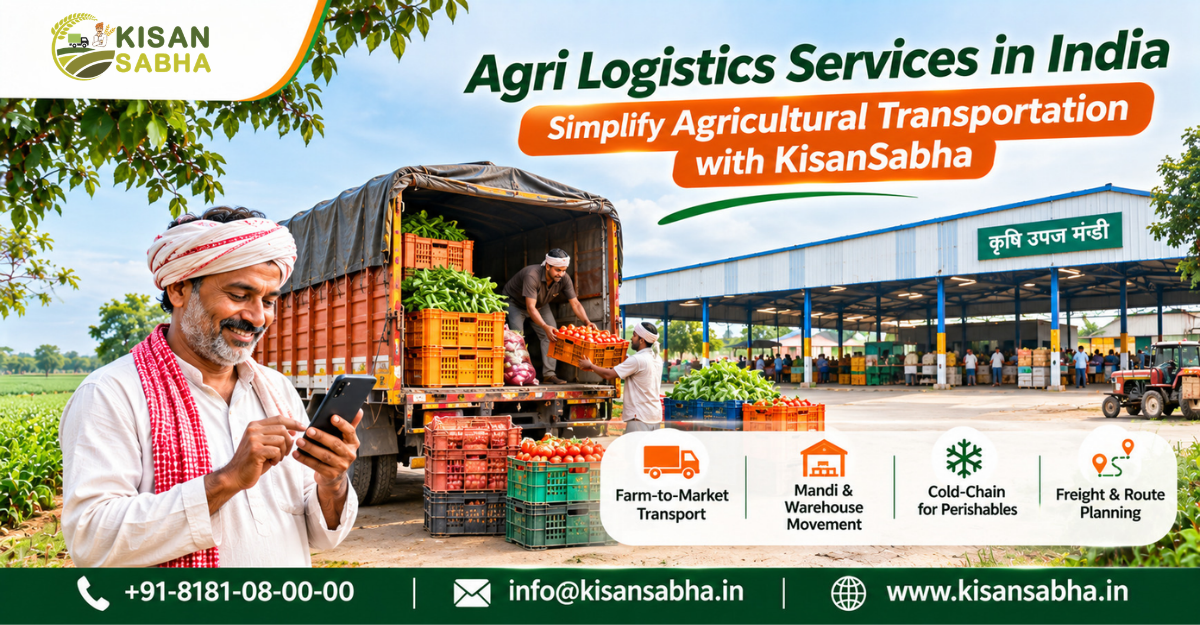
Agri logistics services help manage the transportation and distribution of agricultural commodities from farms and collection centres to markets, warehouses, processing facilities and buyers.
KisanSabha provides a digital agricultural platform where farmers, transporters, mandi dealers and buyers can explore transportation-related requirements, truck booking facilities and freight estimation.
Whether you need to move wheat from a farm in Uttar Pradesh, arrange bulk transportation for an FPO in Haryana or transport vegetables to a wholesale market, choosing a suitable transportation arrangement is an important part of agricultural business operations.
Explore how KisanSabha Agri Logistics can support your farm-to-market transportation requirements.
What Are Agri Logistics Services?
Agri logistics services involve coordinating the movement, handling and distribution of agricultural products throughout the supply chain.
These services help connect agricultural producers, transportation providers, traders, storage facilities and buyers.
Depending on the commodity and shipment requirements, agricultural logistics can include:
- Farm-to-market transportation.
- Agricultural truck booking.
- Mandi-to-warehouse movement.
- Warehouse-to-buyer deliveries.
- Bulk transportation for FPOs.
- Agricultural load discovery and matching.
- Freight estimation and transportation planning.
- Shipment coordination and available tracking facilities.
- Cold-chain transportation for suitable perishable commodities.
For example, a farmer transporting 100 quintals of wheat needs a vehicle with sufficient payload capacity and suitable cargo protection. A vegetable wholesaler moving fresh produce may need a different vehicle and more careful delivery planning.
The right logistics arrangement depends on the commodity, quantity, pickup location, destination and delivery requirements.
Why Is Agricultural Transportation Important for Indian Businesses?
India’s agricultural supply chain connects thousands of production locations with mandis, wholesale markets, warehouses, processing facilities and consumers.
Transportation plays an important role in making these connections possible.
For farmers and agricultural businesses, an organised logistics arrangement can help with:
Market connectivity: Explore transportation options for moving produce beyond the immediate farm or village.
Freight planning: Understand the factors affecting transportation costs before finalising a shipment.
Vehicle suitability: Select transportation according to cargo type, quantity and handling requirements.
Business coordination: Share pickup, delivery, loading and shipment information with relevant participants.
Supply-chain continuity: Coordinate the movement of agricultural goods between farms, mandis, warehouses and buyers.
The importance of logistics also becomes clear when considering India’s post-harvest infrastructure requirements.
A Government of India study conducted through NABARD Consultancy Services (NABCONS), covering 54 commodities across 15 agro-climatic zones during 2020–22, estimated post-harvest losses of 3.89%–5.92% for cereals, 6.02%–15.05% for fruits and 4.87%–11.61% for vegetables.
These estimates cover multiple stages of the post-harvest chain, not transportation alone. They highlight the importance of better coordination across harvesting, handling, packaging, transportation and storage.
Agricultural Transportation Services Available Through Different Supply-Chain Stages
Agricultural goods may travel through several locations before reaching their final buyer.
KisanSabha’s Agri Logistics service page describes transportation requirements across different stages of agricultural movement.
1. Farm-to-Market Transportation
Farm-to-market transportation connects farmers with mandis, wholesale markets, collection centres and buyers.
It is particularly relevant during harvesting periods when agricultural produce needs to be moved within a suitable time.
Before arranging transportation, confirm:
- Commodity name and quantity.
- Farm or collection-centre location.
- Destination mandi or buyer location.
- Required truck capacity.
- Loading arrangements.
- Expected dispatch date.
2. Mandi-to-Warehouse Transportation
Mandi dealers, traders and agricultural businesses may need to move purchased commodities from markets to warehouses or godowns.
The transportation arrangement should account for cargo weight, packaging, vehicle capacity and unloading requirements.
3. Warehouse-to-Buyer Transportation
Agricultural produce stored in warehouses may need to reach wholesalers, processors, retailers and other buyers.
This movement requires coordination between the warehouse operator, transporter and receiving business.
4. Local Agricultural Goods Transportation
Local transportation supports the movement of agricultural commodities between nearby farms, mandis, warehouses and collection centres.
It can be useful for farmers and smaller agricultural traders who regularly move produce within their district or surrounding markets.
5. Inter-State Agricultural Transportation
Agricultural commodities also move between states to connect production regions with consumption and processing markets.
For example, a shipment originating in Uttar Pradesh may need transportation to a wholesale buyer in Delhi NCR. Similarly, agricultural commodities from Haryana, Punjab, Rajasthan and Maharashtra may require suitable long-distance transportation arrangements.
The vehicle, route, freight and cargo-handling requirements should be evaluated for each shipment.
Who Can Use KisanSabha Agri Logistics Services?
Agricultural transportation is required by several participants, not just farmers.
KisanSabha’s digital agricultural network is designed to connect different stakeholders involved in agricultural goods movement.
Farmers
Farmers can explore transportation facilities for moving harvested produce from farms to mandis, collection centres, warehouses and buyers.
Farmer Producer Organisations (FPOs)
FPOs coordinate agricultural activities for multiple farmers and may need to arrange transportation for aggregated produce.
They can explore suitable truck requirements based on shipment quantities, pickup points and destinations.
Mandi Dealers and Agricultural Traders
Mandi dealers and traders require transportation for moving commodities between markets, storage facilities and buyers.
They can explore transportation-related connections for their business requirements.
Wholesalers and Agricultural Buyers
Buyers purchasing agricultural produce from different regions need suitable vehicles to collect and transport goods to their business locations.
Transporters and Truck Owners
Transporters need suitable cargo opportunities for their vehicles.
They can explore agricultural load requirements and potential business connections based on route, cargo weight and vehicle capacity.
How to Arrange Agricultural Transportation Through KisanSabha
A well-prepared transportation requirement makes it easier for a transporter to understand your shipment.
Follow these steps before exploring truck booking options.
Step 1: Prepare Your Shipment Information
Collect the essential details:
- Pickup location.
- Delivery destination.
- Agricultural commodity.
- Estimated cargo weight.
- Number of vehicles required.
- Preferred loading date.
- Required vehicle type.
Step 2: Identify the Appropriate Vehicle
Select a vehicle based on the quantity, dimensions, packaging and handling requirements of your agricultural goods.
For example:
| Agricultural commodity | Vehicle and handling considerations |
| Wheat and rice | Suitable payload and moisture protection |
| Pulses and seeds | Clean and dry cargo space |
| Potatoes and onions | Appropriate ventilation and stacking |
| Fresh fruits | Protective packaging and careful handling |
| Vegetables | Suitable ventilation and delivery planning |
| Temperature-sensitive produce | Appropriate refrigerated transportation |
Do not select a vehicle only by its stated capacity. Confirm its actual suitability for your cargo.
Step 3: Explore Available Transportation Options
Use relevant transportation networks and digital facilities to explore suitable transporters for your route and shipment requirements.
Availability will depend on the pickup location, destination, vehicle category and participating transporters.
Step 4: Estimate Freight Charges
Freight costs can vary according to distance, vehicle type, load weight, tolls, loading and unloading and other commercial conditions.
Use the KisanSabha Freight Calculator to estimate transportation expenses using shipment details.
The result should be treated as an estimate rather than a guaranteed final quotation.
Step 5: Confirm the Booking Terms
Before dispatch, clarify:
- Final freight amount.
- Vehicle and driver information.
- Loading and unloading responsibility.
- Advance and balance payment.
- Waiting charges.
- Pickup and delivery schedule.
- Applicable additional expenses.
Confirm all important terms with the transporter before the vehicle is dispatched.
How Does KisanSabha Freight Calculation Help?
Transportation cost is an important consideration when planning agricultural shipments.
A freight estimate helps farmers, traders and FPOs prepare an initial transportation budget.
KisanSabha provides a Freight Calculator that allows users to enter relevant shipment information, including:
- Source city.
- Destination city.
- Agricultural material.
- Shipment weight.
- Truck type.
Based on the provided information, users can obtain an estimated transportation cost.
Why use a freight estimate?
- Prepare an initial transport budget.
- Understand the expected freight requirement.
- Compare available commercial quotations.
- Plan the transportation of bulk produce.
- Discuss freight terms with transporters.
Remember that actual freight may vary due to route conditions, tolls, vehicle availability, cargo requirements and additional charges.
Calculate Agricultural Transportation Charges
How Digital Agri Logistics Can Support Transporters and Truck Owners
Agricultural transportation is also an important business opportunity for vehicle owners.
However, a transporter needs more than an available vehicle. They need suitable loads, workable routes and clear commercial terms.
Digital load discovery can provide an additional channel for exploring transportation requirements.
KisanSabha’s Agri Logistics page describes facilities such as load matching and transportation connections.
For transporters, the potential advantages include:
- Exploring agricultural cargo requirements.
- Discovering potential customers.
- Evaluating shipment weight and routes.
- Identifying suitable transportation opportunities.
- Exploring return-load possibilities.
- Connecting with agricultural businesses.
For example, a truck completing a delivery to a wholesale market may explore a suitable return shipment instead of travelling back empty.
A return load must still meet the vehicle’s capacity, route, cargo and timing requirements.
What Should You Check Before Selecting an Agricultural Transporter?
Choosing a transporter is a commercial decision. The lowest quotation does not necessarily represent the most suitable service.
Use the following checklist before confirming your shipment.
| Checkpoint | What to verify |
| Vehicle capacity | Is the truck suitable for the cargo weight? |
| Vehicle condition | Is it appropriate for the commodity? |
| Transporter details | Are contact and business details available? |
| Driver information | Are the relevant driver details available? |
| Freight quotation | Are all charges clearly explained? |
| Loading arrangements | Who is responsible for loading and unloading? |
| Delivery schedule | Is the expected delivery time agreed? |
| Payment terms | Are advance and balance payments clear? |
| Shipment documentation | Are booking and delivery records maintained? |
For perishable goods, also confirm whether the vehicle can meet the required temperature, packaging and handling conditions.
Why Explore KisanSabha for Agricultural Logistics?
KisanSabha is a digital agricultural platform that aims to connect farmers, transporters, mandi dealers, buyers and agricultural service providers.
Its Agri Logistics service provides a place to explore transportation-related facilities for agricultural businesses.
Users can explore the following service areas, subject to current availability and applicable terms.
Truck booking facilities: Explore transportation options for agricultural shipment requirements.
Load matching: Discover potential connections between cargo requirements and transporters.
Freight estimation: Use the Freight Calculator to estimate transportation expenses.
Shipment-related facilities: Explore available tracking and coordination features.
Multiple transportation stages: Consider farm-to-market, market-to-warehouse, warehouse-to-store, local and long-distance movements.
The platform’s purpose is to make agricultural transportation requirements easier to explore and coordinate through digital participation.
Frequently Asked Questions About Agri Logistics Services
1. What are agri logistics services?
Agri logistics services involve coordinating the transportation, handling and distribution of agricultural products from farms to mandis, warehouses, processing facilities and buyers.
2. How can I find a truck for agricultural transportation in India?
Prepare your pickup location, destination, commodity, weight, vehicle requirement and loading date. You can explore local transporter networks or digital agricultural transportation platforms such as KisanSabha.
3. Can farmers use KisanSabha for agricultural truck booking?
KisanSabha’s Agri Logistics service is designed to help farmers explore transportation-related facilities for moving agricultural produce. Confirm the available booking options and terms on the platform.
4. How can I calculate freight charges for agricultural goods?
Freight charges depend on distance, vehicle type, shipment weight, tolls, loading and unloading and other commercial factors. KisanSabha provides an online Freight Calculator for initial cost estimation.
5. Can FPOs arrange bulk agricultural transportation?
FPOs can organise shipment quantities from participating farmers and explore suitable vehicles for consolidated transportation. Vehicle selection should consider total weight, pickup points, destination and commodity requirements.
6. Can truck owners find agricultural loads through digital platforms?
Digital load platforms can help transporters discover agricultural transportation requirements and explore potential customers. Actual load availability depends on the route, vehicle and participating users.
7. What factors affect agricultural transportation costs?
The main factors include route distance, truck capacity, cargo weight, commodity type, toll charges, loading and unloading expenses, waiting time and vehicle availability.
8. Does agri logistics include cold-chain transportation?
Yes. Cold-chain transportation is an important component for agricultural and food products that require controlled temperature conditions. The appropriate vehicle depends on the commodity and its storage and transit requirements.
Explore Agricultural Transportation Options with KisanSabha
Moving agricultural produce efficiently requires suitable vehicles, clear freight terms and coordination between farmers, transporters, traders and buyers.
Whether you are a farmer arranging crop transportation, an FPO planning bulk movement, a mandi dealer organising deliveries or a transporter exploring agricultural load opportunities, the right logistics arrangement can help you plan your operations more effectively.
KisanSabha brings agricultural participants together through its digital platform and provides facilities for exploring truck-related services, load opportunities and freight estimation