
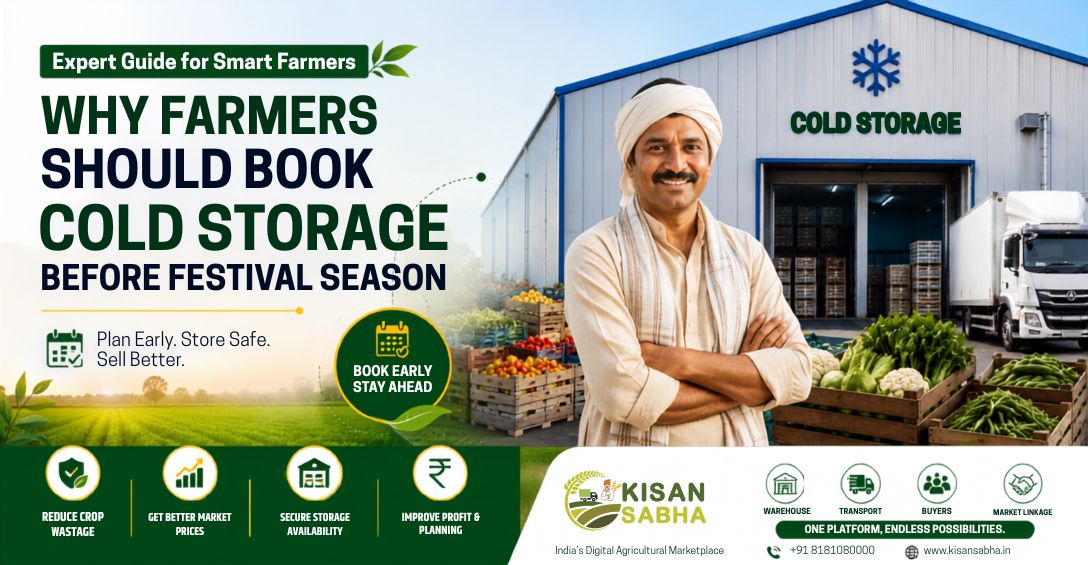
Festival season can change the agricultural market quickly. As Diwali, Dussehra, and Onam approach, demand for fruits, vegetables, potatoes, onions, flowers, and other farm products can rise in many markets. At the same time, more farmers look for safe places to keep their produce until they find a better selling opportunity.
This is where cold storage for farmers becomes important. Instead of rushing to sell immediately after harvest, farmers can store suitable crops under controlled conditions and plan their sales more carefully. However, storage space can become difficult to find when demand peaks. Booking early can therefore give farmers more control over their produce, timing, and selling decisions.
Why Cold Storage Demand Spikes Before Festivals
Indian festivals often create a temporary increase in demand for agricultural products. Households, retailers, restaurants, food businesses, and traders may purchase larger quantities before major celebrations.
For example, demand for certain fruits, vegetables, flowers, and other perishables may increase around Diwali and Dussehra. Onam can also create strong seasonal demand in Kerala and nearby markets. When several buyers enter the market at the same time, prices can move quickly.
This seasonal pattern can create both opportunities and uncertainty. A farmer who has safe storage may have more flexibility to wait for a suitable buyer, while a farmer without storage may feel pressure to sell immediately.
The availability of storage can also tighten before festivals. Traders and farmers may book facilities in advance, leaving limited space closer to the peak period. This is why cold storage booking India becomes especially relevant before major seasonal demand.
Cold storage does not automatically guarantee a higher price. Instead, it gives farmers an additional option: store first and decide when and where to sell based on market conditions.
What Happens When Farmers Don’t Book Early
Waiting until the last moment can create several practical problems. These risks are especially important for farmers handling crops that lose quality quickly.
1. Storage space may not be available
During peak harvest and festival periods, nearby facilities can fill up quickly. A farmer may then have to travel farther or settle for whatever space is available.
2. Produce may lose quality
If crops remain exposed to heat, humidity, or unsuitable conditions for too long, their quality can decline. Spoilage and quality loss directly affect the farmer’s selling value.
3. Farmers may face a sudden price drop
Festival demand does not always mean prices will continuously rise. If many farmers bring the same crop to the market at once, prices can fall.
Having suitable crop storage solutions can provide some flexibility during such price movements.
4. Last-minute storage can cost more
When available facilities are limited, farmers may have fewer choices regarding location, terms, or cost.
5. Distress selling becomes more likely
When there is no safe place to keep harvested produce, farmers may accept a lower price simply because they need to sell quickly.
Good post-harvest storage India practices can help reduce this pressure by protecting produce after harvest and giving farmers more time to make selling decisions.
Benefits of Booking Cold Storage in Advance
Booking storage before demand peaks can offer several practical advantages:
- Better availability: Early booking improves the chance of getting space at a suitable facility.
- More selling flexibility: Farmers can avoid selling immediately only because storage is unavailable.
- Lower wastage risk: Proper storage conditions can help maintain crop quality for suitable products.
- Better planning: Farmers can plan transport, buyers, and market visits around their expected storage period.
- More choice: Early planning can give farmers more options for location, capacity, and pricing.
- Stronger negotiation position: When farmers are not forced to sell immediately, they may have more time to compare buyers and offers.
The larger goal is simple: reduce crop wastage while giving farmers greater control over the period between harvest and sale.
However, farmers should always check whether a particular crop is suitable for cold storage. Different crops need different temperature and humidity conditions, and not every facility is suitable for every commodity.
How to Choose the Right Cold Storage Facility
Before booking, compare facilities carefully. A low storage price is not useful if the facility is unsuitable for your crop.
Use this checklist:
Location
Choose a facility that is reasonably close to your farm, mandi, or planned transport route. Searching for a cold storage near me can help identify nearby options, but distance should not be the only deciding factor.
Capacity
Check whether the facility has enough space for your expected quantity. Ask about the minimum and maximum quantity accepted.
Temperature Control
Confirm the temperature range required for your crop and whether the facility can maintain it consistently.
Temperature control means keeping the storage environment within a planned temperature range to protect crop quality.
Cost
Ask for the complete cost structure. Check whether charges are calculated per quintal, bag, crate, day, month, or storage period. Also ask about loading, unloading, handling, and other possible charges.
Certifications and Standards
Check the facility’s registration, applicable approvals, safety arrangements, and quality practices. For government schemes or subsidies, verify current eligibility directly from the relevant government department.
Handling and Security
Ask how crops are loaded, stacked, monitored, and released. Good handling can be just as important as temperature control.
How KisanSabha Makes Cold Storage Booking Easy
Finding suitable storage should not become another difficult task during the busiest part of the farming season. KisanSabha is designed as a digital agricultural marketplace that connects farmers with different parts of the agricultural ecosystem.
Through KisanSabha, farmers can explore agricultural services and make better-informed decisions around their crop movement and storage needs. Instead of waiting until the festival rush begins, farmers can plan their storage requirement earlier.
The idea is simple: plan your storage before you need it urgently. Whether you are comparing a warehouse for crops, looking for transport support, or planning where to sell your produce, having the right information at the right time can make farm operations easier.
For farmers searching for cold storage booking India, digital platforms can make the process more convenient by bringing agricultural services closer to the people who need them.
FAQ
Answer: Farmers should ideally start checking availability several weeks before their expected harvest or the festival demand period. Early booking provides more choice of facilities and storage capacity.
Answer: Cold storage costs vary by crop, location, storage duration, facility, capacity, and handling charges. Farmers should confirm the complete pricing structure with the facility before booking.
Answer: Many fruits and vegetables can be stored in cold storage, but each crop has different temperature and humidity requirements. Farmers should confirm that the facility is suitable for their specific crop.
Answer: Cold storage can be beneficial when the crop is suitable for storage and waiting may provide better selling flexibility. Farmers should compare storage costs, expected prices, crop quality, and market demand before deciding.
Answer: Farmers can search online, contact local agricultural networks, or use digital agricultural marketplaces to find nearby facilities. They should compare location, capacity, crop suitability, cost, and facility standards before booking.
Final Takeaway
Festival season can create new market opportunities, but it can also put pressure on storage capacity and crop prices. Farmers who plan ahead can avoid making rushed decisions when storage space becomes limited.
If your crop is suitable for controlled storage, consider booking cold storage for farmers before the seasonal rush begins. Explore your options, compare facilities, plan transportation, and make your selling decision with better information.
Register on KisanSabha and plan your crop storage and market journey before festival demand peaks.