
Agricultural marketplaces are changing how farmers, buyers, traders, and agri-businesses connect in India. Instead of depending only on a local mandi or a network of intermediaries, farmers can use digital agricultural marketplaces to discover buyers, compare market information, list agricultural produce, and access logistics and related services from one platform.
Platforms such as KisanSabha bring important parts of the agricultural supply chain together, including produce listings, buyer and seller connections, mandi rate information, transport support, and agricultural service discovery.
What Is an Agricultural Marketplace?
An agricultural marketplace is a digital platform that connects farmers, buyers, traders, mandi dealers, and agri-businesses for the buying and selling of agricultural products and services.
Depending on the platform, farmers may be able to list commodities such as grains, fruits, vegetables, spices, cotton, and other agricultural products. Buyers can search for available produce, connect with sellers, and discuss price and delivery requirements.
Unlike a traditional physical mandi, a digital agricultural marketplace is not restricted to buyers who are physically present at one location. A farmer can use a mobile phone or website to reach a wider network of potential buyers and agricultural businesses.
The original article describes this shift as moving from fragmented, local transactions toward a searchable and connected agricultural network.
Why Are Agricultural Marketplaces Important for Indian Farmers?
Indian agriculture involves a large network of farmers, traders, buyers, transporters, storage providers, input dealers, and other service providers.
Traditionally, farmers have often depended on local networks to sell their produce and arrange transportation. This can make it difficult to compare prices, reach buyers outside the local market, or coordinate logistics.
An agricultural marketplace can help bring these activities into a more connected digital environment.
Key challenges in traditional agricultural trading
Farmers may face challenges such as:
- Limited visibility of prices outside their local market
- Dependence on local agents and intermediaries
- Limited access to buyers beyond the nearby mandi
- Difficulty arranging transportation after finding a buyer
- Delays in selling perishable agricultural produce
- Separate processes for finding storage, transport, and other services
These challenges are among the reasons digital agricultural marketplaces are becoming increasingly relevant to the agricultural supply chain.
Traditional Mandi vs Digital Agricultural Marketplace
| Factor | Traditional Mandi | Digital Agricultural Marketplace |
|---|---|---|
| Price visibility | Primarily local | Wider market visibility |
| Buyer reach | Buyers visiting the mandi | Buyers and businesses connected digitally |
| Access | Physical presence generally required | Mobile or website access |
| Product discovery | Local market network | Search and digital listings |
| Logistics | Often arranged separately | May include transport and storage connections |
| Market connections | Primarily local | Potentially wider network |
The key difference is accessibility. A traditional mandi is a physical market, while a digital agricultural marketplace can extend market connections beyond a single location.
How Does an Agricultural Marketplace Work?
The process is generally straightforward.
1. Farmer registers on the platform
The farmer creates an account and provides basic information such as location and stakeholder details.
2. Farmer lists agricultural produce
The farmer can provide information about the commodity, quantity, quality, price expectations, and other relevant details.
3. Buyers search for agricultural products
Buyers, traders, processors, or other businesses can search for commodities based on their requirements.
4. Price discovery takes place
Farmers can use available market information, including mandi rates where provided, to understand current pricing before negotiating.
5. Buyer and seller connect
The interested parties communicate and discuss price, quantity, quality, and delivery requirements.
6. Transportation and delivery are arranged
Once a transaction is finalized, logistics become an important part of completing the agricultural trade. Platforms that provide transport, warehousing, or related services can help users manage these requirements more efficiently.
This listing, discovery, connection, price-checking, and logistics process is the core concept behind a digital agricultural marketplace.
Benefits of Using an Agricultural Marketplace
A well-designed agricultural marketplace can provide several advantages to farmers and buyers.
1. Wider Buyer Reach
Farmers are not limited to buyers who visit their local mandi. Digital listings can help them connect with buyers and businesses across a wider geographic area.
2. Better Price Visibility
Access to current mandi rate information can help farmers understand market conditions before deciding on a selling price.
3. Direct Market Connections
Digital platforms can make it easier for farmers and buyers to discover and communicate with each other.
4. Easier Logistics Coordination
Selling agricultural produce is only one part of the process. Transportation and storage are also important. A marketplace that connects users with logistics services can make the overall process more convenient.
5. Access to Agricultural Services
An agricultural marketplace can extend beyond produce trading by connecting farmers with services such as transporters, warehouses, cold storage providers, agri-input dealers, and other agricultural businesses.
These benefits reflect the original article’s emphasis on price visibility, wider market reach, reduced post-harvest delays, and access to the broader agricultural ecosystem.
What Should You Look for in a Farmers Marketplace App?
Choosing an agricultural marketplace app requires more than checking whether it allows produce listings.
Farmers and buyers should consider the following features:
Regional Language Support
Indian agriculture includes users with different language preferences. Regional-language support can make digital agricultural services easier to use.
Simple Mobile Experience
A mobile-first design with straightforward navigation can make it easier for farmers to list products, search for buyers, and check market information.
Verified Users and Business Information
Clear user and business information can help create greater confidence when connecting with buyers, sellers, and service providers.
Digital Payment Options
Payment support can make settlement more convenient after a transaction is completed.
Logistics and Warehousing Connections
Agricultural trading does not end when a buyer and seller agree on a price. Transportation and storage are critical parts of the supply chain.
Current Mandi Rate Information
Farmers can benefit from access to updated mandi rate information when evaluating potential selling prices.
The original article identifies regional languages, mobile-first design, verification, payments, logistics, warehousing, and mandi-rate access as important marketplace features.
KisanSabha Agricultural Marketplace: How It Helps Farmers and Buyers
KisanSabha‘s agricultural marketplace is designed to bring multiple agricultural market and logistics functions together on one platform.
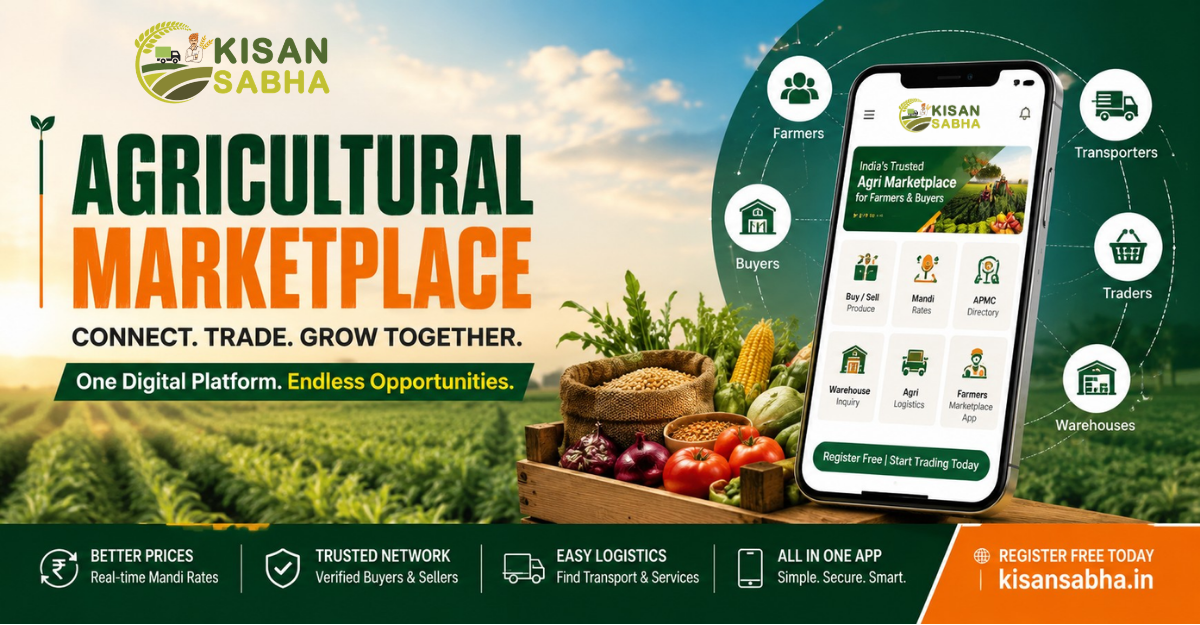
According to the source content, KisanSabha combines produce listings, buy and sell leads, live mandi rates, an APMC directory, load posting, truck finding, and warehouse inquiries. This means users can access market and logistics-related tools without having to depend entirely on multiple separate platforms.
Farmers can list agricultural produce with relevant details and connect with mandi dealers or buyers across different commodity categories. The platform also provides access to logistics-related tools that can help users coordinate transportation and warehousing.
Agricultural services available through the wider KisanSabha ecosystem
The platform’s agricultural ecosystem can help users discover connections related to:
- Agricultural produce
- Buyers and sellers
- Mandi dealers
- Transporters
- Warehouses
- Cold storage
- Agricultural input services
- Other agri-business services
This broader ecosystem is important because agricultural trade involves more than simply finding a buyer. Farmers also need reliable market information, transportation, storage, and other services.
How to Register on an Agricultural Marketplace
Getting started with an agricultural marketplace generally involves a few simple steps.
Step 1: Register
Create an account using the platform’s registration process.
KisanSabha offers free registration for users such as farmers, buyers, mandi dealers, transporters, and agricultural service providers.
Step 2: Complete Your Profile
Add relevant details such as:
- Location
- Agricultural commodities
- Business information
- Services offered
- Other required profile information
Step 3: List or Search
Farmers can list their available produce, while buyers can search for products or post their requirements.
Step 4: Check Mandi Rates
Review available mandi rate information before finalizing a selling or buying decision.
Step 5: Connect With the Other Party
Contact the relevant buyer, seller, mandi dealer, or service provider and discuss the transaction.
Step 6: Arrange Logistics
Once the deal is finalized, arrange transportation, storage, and delivery according to the requirements of the transaction.
The source describes this six-step flow as registration, profile completion, listing/browsing, checking mandi rates, connecting and negotiating, and arranging logistics and payment.
Agricultural Marketplace vs eNAM
Agricultural marketplaces and eNAM serve related but different purposes.
eNAM is associated with digital integration of regulated agricultural markets and price discovery, while a private agricultural marketplace such as KisanSabha can provide direct connections between farmers, buyers, and agricultural service providers.
For farmers, these platforms can therefore serve complementary purposes depending on what they need, such as market-price information, buyer connections, agricultural services, or logistics support.
What Can You Buy or Sell on an Agricultural Marketplace?
The exact commodities depend on the platform and available buyers or sellers.
An agricultural marketplace can support categories such as:
- Grains
- Fruits
- Vegetables
- Spices
- Cotton
- Dairy and other agricultural commodities
- Seeds and agricultural inputs
- Other farm-related products
The source specifically mentions grain, fruit, vegetables, spices, cotton, dairy, and other commodities, along with related agricultural services.
Do Farmers Need a Smartphone to Use an Agricultural Marketplace?
Most modern farmers marketplace apps are designed with mobile users in mind.
A smartphone can make it easier to:
- Create a profile
- List agricultural produce
- Check mandi rates
- Search for buyers
- Respond to leads
- Contact agricultural businesses
- Coordinate logistics
KisanSabha’s marketplace is described in the source as mobile-focused and available with multiple Indian-language support.
Frequently Asked Questions About Agricultural Marketplaces
An agricultural marketplace is a digital platform that connects farmers, buyers, traders, mandi dealers, and agri-businesses for agricultural products and services. It can help users discover market opportunities, compare available information, and connect with other participants in the agricultural supply chain.
Key benefits include wider buyer reach, better price visibility, direct connections, easier product discovery, and access to related logistics and agricultural services.
According to the source content, KisanSabha provides free registration for farmers, buyers, mandi dealers, and other agricultural stakeholders.
A traditional mandi is a physical market where buyers and sellers meet at a particular location. A digital agricultural marketplace uses online technology to connect participants beyond a single physical market and can also provide digital listings, market information, and logistics-related services.
eNAM focuses on digitally connecting regulated APMC markets, while a private agricultural marketplace such as KisanSabha can provide direct connections between farmers, buyers, traders, and agricultural service providers.
Depending on the platform, farmers can list agricultural commodities such as grains, fruits, vegetables, spices, cotton, dairy, and other farm products.
Yes. Farmers marketplace apps are generally designed for mobile use. KisanSabha’s marketplace is described as mobile-focused and supports multiple Indian language
The Future of Agricultural Marketplaces in India
Agricultural trade in India is becoming increasingly connected through digital platforms.
The role of an agricultural marketplace is not limited to putting buyers and sellers together. The larger opportunity is to connect the different stages of the agricultural supply chain, from price discovery and produce listing to buyer connections, transportation, storage, and related services.
For farmers, this can mean easier access to market information and a broader network of potential business connections. For buyers and agri-businesses, digital marketplaces can make it easier to discover agricultural products and service providers.
As digital adoption grows, agricultural marketplaces can become an increasingly important part of India’s farm-to-market ecosystem.
Conclusion
An agricultural marketplace in India provides a digital way for farmers, buyers, traders, mandi dealers, and agri-businesses to connect.
Instead of depending only on a local mandi or separate channels for every stage of a transaction, farmers can use digital platforms to list produce, discover buyers, check mandi rates, connect with agricultural businesses, and explore logistics and storage services.
KisanSabha brings these functions together through its agricultural marketplace and wider agri-business ecosystem, giving farmers and other agricultural stakeholders a single digital platform for market and supply-chain connections.
Ready to explore a digital agricultural marketplace? Register on KisanSabha and start connecting with India’s agricultural ecosystem.