
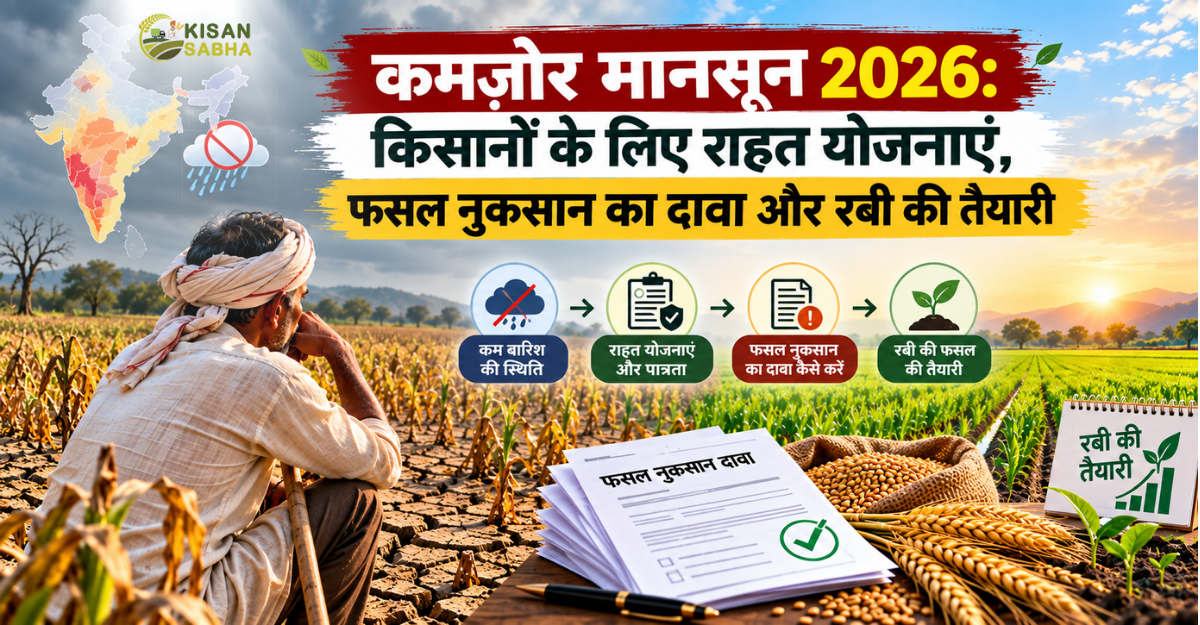
This year’s monsoon began late and stayed weak. Now that it is withdrawing, many farmers are counting losses instead of celebrating a good harvest. If your fields are dry, your crop is stressed, or you are wondering how drought will change prices and freight, this guide is for you.
It explains what happened, how a drought is officially declared, how to protect your claim for relief, and how to plan the next few months. It uses simple language and gives practical steps, with tools from KisanSabha at each stage.
What Went Wrong With the 2026 Monsoon
The warning signs came early. The monsoon reached Kerala on 4 June, three days later than normal, and the IMD forecast below-normal rainfall at 90% of the long-period average, expecting El Niño to develop during the season. El Niño is a warming of the Pacific Ocean that usually suppresses rain over India.
The season then started badly. June opened with a steep 40% rainfall deficit, and by 29 June about 76% of districts had received deficient, largely deficient or no rain. July brought some recovery, but as of 2 August the season was still 12% below the long-period average, and around 47% of districts had recorded deficient or largely deficient rainfall. More recent summaries put the shortfall at around 15% below normal. These figures shift as the season closes, so treat IMD’s final number as the official one.
The damage is worse than the national average suggests, because of when the rain failed. A Down to Earth report on the government’s crop-monitoring briefing describes dry spells of two to three weeks and weak crop conditions in parts of Rajasthan, Gujarat, Maharashtra, Karnataka, Andhra Pradesh and Tamil Nadu. A dry spell during flowering or grain filling hurts yield far more than the same spell early in the season.
The report’s headline finding is that more than half of India is under dry or drought-like conditions. The monsoon has also started leaving the country. A daily agriculture bulletin notes that its withdrawal from Rajasthan began on 20 September, so there is little time left for the season to make up its losses.
How a Drought Is Actually Declared
Many farmers wonder why relief does not arrive the day the rain fails. The reason is that a drought is declared in stages, not on a single day.
Under India’s drought management guidelines, states first check “triggers” based on rainfall and dry-spell data. If those are met, field-level checks follow to measure the real impact on crops, using indicators such as satellite vegetation data, soil moisture and sown area. Only after those checks does the state confirm the drought and unlock the fuller relief package.
Maharashtra shows this clearly. An official of the state’s relief department explained that a drought can be formally declared only after the second trigger is assessed. This is why surveys and paperwork carry so much weight. The declaration is the first step, and the money follows the assessment.
Maharashtra: The Clearest Picture of Drought Stress
Maharashtra shows how severe the situation is. Marathwada and north Maharashtra have large rainfall deficits. Chhatrapati Sambhajinagar received only 29.8% of its normal rainfall, and Nashik recorded 34.3%. Reports say about 21 districts face water shortages, and eight tehsils in Solapur may report crop losses of 80–90%.
On 26 September, the state government declared 265 of its 358 talukas drought-affected, covering 74 per cent of the state. The relief announced so far includes:
- Restructuring of crop loans
- Concession in land revenue
- Deferment of recovery of agriculture-related loans
- No disconnection of electricity to agricultural pumps in villages facing water scarcity
- Drinking-water tankers, fodder for livestock and water-conservation works where needed
One important point: direct compensation for crop losses has not yet been announced. The resolution says assistance will be declared separately after the prescribed assessment process, which makes the ongoing field surveys and panchnamas critical. Chief Minister Devendra Fadnavis has said affected farmers will be given proper help, and crop-inspection reports have now begun in the drought-hit areas.
If you farm in an affected area, the survey is the step that matters most.
Your Step-by-Step Guide to Protecting a Relief Claim
Most claims fail on paperwork, not on the loss itself. Follow these steps:
- Report the loss early. Tell your village-level agriculture officer or revenue office as soon as you see damage. Get a written acknowledgement or a receipt number.
- Photograph everything. Take dated photos of your standing crop, dry soil and empty water sources. If you have several plots, photograph each one separately.
- Keep your input records. Save bills for seed, fertiliser and pesticide, plus diesel or irrigation costs. These show how much you invested.
- Check your crop insurance. Under schemes such as PMFBY, some events must be reported within a short window, sometimes as little as 72 hours, and the rules differ by event type. Read your policy or ask your insurer today. To find a professional, use the insurance agent directory.
- Attend the panchnama. This is the formal loss survey. Be present, show your fields, and check that your survey number and crop are recorded correctly.
- Ask your bank about restructuring. If your area is declared, loan restructuring and deferment may apply. Visit before your instalment falls due. The bank listings for farmers can help you find the right contact.
- Check your land and farmer records. Errors in names, survey numbers or bank details are a common cause of delayed payments.
Rules vary by state and scheme, so confirm details with your local agriculture office.
A Special Word for Women Farmers
Women do a large share of farm work, but relief often misses them because many schemes identify a farmer through land ownership. Maharashtra has now become the first state to pass the Women Farmers Empowerment Bill, 2026. It gives women a “Woman Farmer Certificate” irrespective of land ownership, and it comes in the year the UN has designated the International Year of the Woman Farmer. See the Drishti IAS analysis for details.
Women in affected areas should ask their local office how the certificate works and keep farm records in their own name where possible.
What Drought Means for Mandi Prices
A short crop usually means fewer arrivals at the mandi, and prices of affected commodities often firm up. But the rise is not guaranteed, and it is not equal for everyone.
- Government stocks and imports can cool prices when supply is tight.
- Farmers who lost their crop may have nothing to sell, so a price rise does not help them.
- Irrigated farmers may benefit if they still have a healthy harvest.
- Quality matters. Drought-stressed grain can be lighter or shrunken, which lowers the price even in a strong market.
Before you sell, always compare. Check the day’s rates on the Mandi Rate page, learn how your local market works through the APMC section, and look up your crop in the Commodity directory.
If you would rather skip the middleman, post what you have on Sell Leads. If you are a buyer or processor, find supply through Buy Leads. Do not rely on one day’s price. Watch the trend for a week or two before you decide.
How Drought Changes Transport and Freight
Drought changes what moves and where. Local harvest loads may fall, but grain, fodder, pulses and vegetables from surplus regions may travel farther to reach deficit ones. Water tankers and fodder loads add demand in declared areas. Longer distances also mean freight takes a bigger share of your final price.
- If you have a load: use Post a Load for full loads above 3 MT, or Part Load Posting for smaller consignments. You can also search vehicles on the Truck Board.
- If you own a truck: list your availability with Post a Truck and watch the Load Board for return loads, so you avoid empty trips.
- Before you agree a rate: check costs with the Freight Calculator and confirm the route on the Distance Calculator.
- If prices are weak and you want to store: send a Warehouse Inquiry, or browse cold stores and godowns.
Rabi Season: How to Plan When Moisture Is Low
Rabi crops depend heavily on stored soil moisture and irrigation, so what you do now matters. These are general good practices, so confirm specifics with your local Krishi Vigyan Kendra (KVK).
1. Measure before you sow. Check soil moisture and soil health first. A soil test tells you what your field can support and stops you from wasting fertiliser. You can find AI-based rapid soil testing providers in the directory.
2. Match the crop to your water. If irrigation is uncertain, ask your KVK about crops and shorter-duration varieties that need less water than your usual choice. Buy certified seed from a trusted seed dealer.
3. Save every drop. Mulching, clean weeding, levelled fields and drip or sprinkler irrigation all cut water loss. Agri solar product suppliers can help with solar pumps, which lower both water and power costs.
4. Time sowing to moisture. Sowing into dry soil wastes seed. Sow when there is enough moisture for germination, and plan any life-saving irrigation for the most sensitive growth stages.
5. Buy inputs early, but compare. Get quotes from local fertilizer dealers and keep your bills.
6. Plan fodder for livestock. Fodder gets scarce in drought. Arrange feed early, and connect with local supply through the livestock farmer directory.
7. Do not put everything into one crop. Spreading your area across two or three crops lowers your risk if the season stays dry.
What Dealers, FPOs and Agri Businesses Should Do
Input demand is shifting. Sales of routine inputs may fall in stressed areas, while demand for irrigation, solar, seed and soil-testing services rises. Businesses can list themselves in the service provider directory, and farmer groups can pool transport and buying through the farmer directory. New users can register free and compare the available packages.
Frequently Asked Questions
States first check rainfall and dry-spell triggers, then assess the actual crop impact using satellite and field data. Formal declaration and full relief follow those checks.
Not yet. Loan restructuring, land revenue concessions and other measures are announced. Direct crop-loss assistance will follow the assessment.
Often for affected crops, but not always. Government stock, imports, quality and demand all matter. Check live rates on theMandi Rate page before selling.
Report the loss to your local officer, take dated photos, keep your input bills, and check your insurance reporting deadline immediately.
Post your requirement onKisanSabha’s load board or browse available vehicles on theTruck Board.
Conclusion
The 2026 monsoon has been weak in both amount and timing, and El Niño has made it worse. Relief is in motion, but it follows a process. Farmers who report early, keep clean records, compare mandi rates and plan rabi around the water they have will be in the strongest position. So will the transporters, dealers and traders who serve them.
Information in this article is current as of 28 September 2026. Rainfall figures change as the season closes, and relief rules differ by state, so please verify with your state agriculture department.