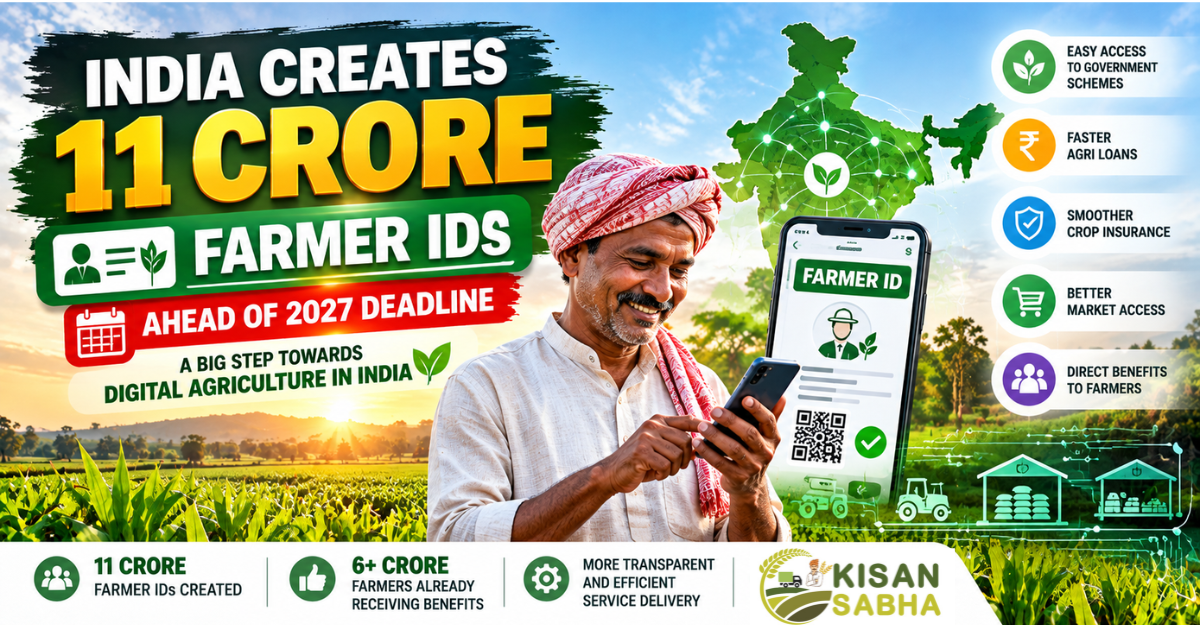
New Delhi, 26 October 2026: India has achieved its target of creating 11 crore Farmer IDs, five months ahead of the March 31, 2027 deadline, according to an announcement by the Ministry of Agriculture and Farmers’ Welfare on October 24. The milestone was achieved under the Centre’s Digital Agriculture Mission, which aims to improve the delivery of agricultural services through digital infrastructure.
Union Agriculture and Farmers’ Welfare Minister Shivraj Singh Chouhan said the target was completed by the night of October 23. The initiative is intended to give farmers a unique digital identity and make access to government schemes, agricultural credit, crop insurance and disaster relief more transparent and efficient.
According to the government’s official announcement published by the Press Information Bureau, more than six crore farmers have already received direct benefits under various schemes through Farmer ID-based service delivery.
The development marks a significant milestone in India’s digital agriculture efforts. It also raises important questions about how digital identification will support farmers in accessing agricultural services, participating in markets and managing their farming businesses.
What Is the 11 Crore Farmer ID Milestone?
The Centre had set a target of creating 11 crore Farmer IDs by March 31, 2027. The government has now achieved that target ahead of schedule through coordination between the Ministry of Agriculture and Farmers’ Welfare, state governments, Union Territory administrations and field-level officials.
Farmer ID is a unique digital identity created under the Digital Agriculture Mission. It is intended to help identify farmers and simplify verification when they access eligible agricultural schemes and services.
The government expects the system to reduce repeated paperwork and make it easier for eligible farmers to access different services without submitting the same information repeatedly.
The announcement is part of a wider effort to develop digital infrastructure for agriculture. The initiative aims to improve coordination between government departments, support the delivery of benefits and strengthen the use of verified agricultural information.
However, achieving the national target does not mean every farmer has completed registration or that every agricultural service will automatically become available through the ID. Farmers should continue to check the applicable state procedures and eligibility requirements for individual schemes.
What Is the Digital Agriculture Mission?
The Digital Agriculture Mission is a government initiative intended to build digital infrastructure for India’s agricultural sector. The Union Cabinet approved the mission on September 2, 2024.
One of its important components is AgriStack, which includes digital systems designed to support farmer identification and the organisation of agricultural information.
The Farmer Registry is intended to create a verified digital identity for farmers. Other components of the wider agricultural digital infrastructure include geo-referenced village maps and the Crop Sown Registry.
Together, these systems are intended to help authorities connect farmer information with agricultural land and crop-related records, subject to applicable rules and data safeguards.
The broader objective is to make agricultural administration more efficient and improve the availability of information for planning and service delivery.
How Could Farmer IDs Help Indian Farmers?
The government says the Farmer ID initiative is intended to simplify access to several important agricultural services. The actual benefits available to an individual farmer will depend on the relevant scheme, eligibility rules and implementation procedures.
1. Access to Government Schemes
A verified digital identity can help authorities establish a farmer’s identity when processing eligible scheme applications.
The system is intended to reduce repeated verification and paperwork. Farmers should nevertheless confirm which documents and registration details are required for each scheme.
2. Agricultural Loans and Kisan Credit Card Services
The government expects Farmer IDs to simplify identity and record verification when farmers seek eligible agricultural credit, including Kisan Credit Card facilities.
The ID itself does not guarantee loan approval. Lending decisions remain subject to the bank’s requirements, eligibility criteria and applicable procedures.
3. Crop Insurance and Disaster Relief
The government has identified crop insurance and disaster relief as important areas where digital farmer records may support service delivery.
In cases of crop loss or natural disasters, better-organised records may help relevant authorities process eligible claims and assistance. Actual assessment, eligibility and payment depend on the applicable insurance or relief programme.
4. Agricultural Procurement and MSP-Related Processes
Farmer IDs are also intended to support agricultural procurement and verification processes, including those associated with Minimum Support Price programmes.
Farmers should not assume that having an ID automatically guarantees procurement at MSP. The applicable crop, procurement arrangements, quality conditions, registration procedures and other rules continue to matter.
5. Reduced Repeated Paperwork
One of the stated objectives is to reduce the need for farmers to submit the same documents repeatedly when accessing different government services.
If implemented effectively, this could reduce administrative effort for farmers and officials. The extent of the benefit will depend on how well the digital systems work with existing state and departmental processes.
More Than Six Crore Farmers Have Received Benefits Through ID-Based Delivery
According to the Ministry of Agriculture and Farmers’ Welfare, more than six crore farmers have already received direct benefits under various schemes through Farmer ID-based service delivery.
The government says a verified farmer database can help reduce duplicate verification, improve coordination among departments and strengthen the monitoring of agricultural programmes.
This figure relates to farmers who have received benefits through the system, as reported by the government. It should not be interpreted as the total number of farmers who have registered or as proof that every registered farmer has received every available benefit.
The next important step will be ensuring that eligible farmers can use the system effectively and that the associated services remain accessible across different regions.
What Should Farmers Know About Registration and Eligibility?
Although the national target has been achieved, farmers should check their individual registration status and the rules that apply in their state.
Registration processes and requirements may differ depending on the state, the availability of digitised land records and the specific scheme involved.
Farmers should consider the following steps:
- Check the current Farmer Registry or AgriStack process through official government channels.
- Confirm that personal information and relevant land records are accurate.
- Ask the local agriculture department or an authorised service centre for assistance if registration details need correction.
- Verify the requirements of the particular scheme or service before applying.
- Keep relevant records and acknowledgements for future reference.
- Use official channels and exercise caution when sharing personal information or verification codes.
Farmers who cultivate leased land or work as sharecroppers should ask their state agriculture department about the applicable registration process. The Ministry has stated that states and Union Territories are taking steps, under applicable rules, to include tenant farmers and actual cultivators in the digital platform.
The practical availability of these provisions may depend on state-level procedures and documentation.
Digital Agriculture and the Future of Agricultural Market Access
Farmer identification is one part of the broader digital transformation of Indian agriculture. Another important area is helping farmers access market information, discover buyers and organise the movement of produce.
Farmers need more than access to government schemes to manage their agricultural businesses. They also need relevant information about market prices, selling opportunities, transport costs, storage facilities and agricultural service providers.
Digital platforms can help bring some of these resources together, making it easier for farmers and other agricultural participants to discover relevant information.
For example, KisanSabha is an agricultural marketplace and information platform that connects farmers, mandi dealers, buyers, transporters and agricultural service providers. Its services address practical activities across the agricultural supply chain.
Farmers can explore the platform to:
- Check available mandi-rate information before making selling decisions.
- Explore potential buyer connections through Sell Leads.
- Investigate transport-related opportunities through the Load Board.
- Post transportation requirements using Post a Load.
- Discover relevant agricultural services through the KisanSabha Directory.
These services serve a different purpose from the government’s Farmer ID initiative. KisanSabha does not issue government Farmer IDs or administer government welfare schemes. Instead, its platform provides agricultural market and supply-chain resources that farmers can explore alongside official government services.
Farmers should independently verify market rates, buyer details, transport quotations and commercial terms before completing transactions.
Key Challenges to Watch as Digital Agriculture Expands
Achieving a national registration target is an important milestone, but the usefulness of a digital system also depends on its implementation.
Several areas will remain important as Farmer ID-based services expand.
Accuracy of Records
Incorrect names, outdated land records or mismatched details can create difficulties during verification. Accessible correction procedures will be important for farmers whose records contain errors.
Access for Tenant Farmers and Actual Cultivators
Farmers who cultivate land without being recorded as its legal owner may face different registration requirements. State-level processes need to address their circumstances in accordance with applicable rules.
Digital Access and Assistance
Farmers with limited internet access, digital literacy or access to smartphones may need support from authorised centres and local officials.
Data Protection and Responsible Use
Digital agricultural systems rely on personal and agricultural information. Clear rules on access, consent, security and the use of records are important to maintaining trust.
The government has described Farmer IDs as a means of improving transparency and service delivery. The longer-term impact will depend on how effectively these systems protect information, include eligible farmers and deliver the intended benefits.
What Happens Next for Digital Agriculture in India?
With the 11 crore Farmer ID target achieved ahead of schedule, attention will turn to the continued use of the system and the effective delivery of services linked to it.
The government has highlighted the potential for simpler verification, improved access to eligible schemes and stronger coordination between departments.
For farmers, the immediate priority is to ensure that their records are accurate, understand the registration requirements in their state and verify the procedures for any scheme they intend to use.
For the wider agricultural sector, digital identification is one part of a larger change involving market information, agricultural services, transport, storage and technology-enabled decision-making.
The success of this transformation will depend not only on the number of IDs created but also on whether farmers can use the resulting services reliably and accessibly.
Frequently Asked Questions About Farmer IDs in India
{ “@context”: “https://schema.org”, “@type”: “FAQPage”, “mainEntity”: [ { “@type”: “Question”, “name”: “How many Farmer IDs has India created?”, “acceptedAnswer”: { “@type”: “Answer”, “text”: “According to the Ministry of Agriculture and Farmers’ Welfare, India achieved its target of creating 11 crore Farmer IDs by the night of October 23, 2026, five months before the March 31, 2027 deadline.” } }, { “@type”: “Question”, “name”: “What is a Farmer ID?”, “acceptedAnswer”: { “@type”: “Answer”, “text”: “A Farmer ID is a unique digital identity created under the Digital Agriculture Mission. It is intended to support verification and access to eligible agricultural schemes and services.” } }, { “@type”: “Question”, “name”: “What is AgriStack?”, “acceptedAnswer”: { “@type”: “Answer”, “text”: “AgriStack is part of India’s digital agriculture infrastructure. It includes systems such as the Farmer Registry, geo-referenced village maps and the Crop Sown Registry.” } }, { “@type”: “Question”, “name”: “How can a Farmer ID help farmers?”, “acceptedAnswer”: { “@type”: “Answer”, “text”: “The government intends Farmer IDs to simplify access to eligible government schemes, agricultural credit, crop insurance, disaster relief and certain procurement-related processes. Actual access depends on applicable rules and eligibility.” } }, { “@type”: “Question”, “name”: “Does a Farmer ID guarantee a crop loan or insurance payment?”, “acceptedAnswer”: { “@type”: “Answer”, “text”: “No. A Farmer ID does not automatically guarantee loan approval, insurance compensation or other benefits. Each service has its own eligibility requirements and procedures.” } }, { “@type”: “Question”, “name”: “Can tenant farmers and sharecroppers register?”, “acceptedAnswer”: { “@type”: “Answer”, “text”: “The government has stated that states and Union Territories are taking steps to include tenant farmers and actual cultivators under applicable rules. Farmers should confirm the procedure with their state agriculture department.” } }, { “@type”: “Question”, “name”: “Where can farmers check official Farmer ID information?”, “acceptedAnswer”: { “@type”: “Answer”, “text”: “Farmers should consult the Ministry of Agriculture and Farmers’ Welfare, their state agriculture department or the relevant official Farmer Registry portal for current registration instructions and requirements.” } }, { “@type”: “Question”, “name”: “How does KisanSabha relate to digital agriculture?”, “acceptedAnswer”: { “@type”: “Answer”, “text”: “KisanSabha is an agricultural marketplace and information platform offering resources related to mandi information, buyer connections, transportation and agricultural services. It is separate from the government Farmer ID programme.” } } ] }1. How many Farmer IDs has India created?
According to the Ministry of Agriculture and Farmers’ Welfare, India achieved its target of creating 11 crore Farmer IDs by the night of October 23, 2026, five months before the March 31, 2027 deadline.
2. What is a Farmer ID?
A Farmer ID is a unique digital identity created under the Digital Agriculture Mission. It is intended to support verification and access to eligible agricultural schemes and services.
3. What is AgriStack?
AgriStack is part of India’s digital agriculture infrastructure. It includes systems such as the Farmer Registry, geo-referenced village maps and the Crop Sown Registry.
4. How can a Farmer ID help farmers?
The government intends Farmer IDs to simplify access to eligible government schemes, agricultural credit, crop insurance, disaster relief and certain procurement-related processes. Actual access depends on applicable rules and eligibility.
5. Does a Farmer ID guarantee a crop loan or insurance payment?
No. A Farmer ID does not automatically guarantee loan approval, insurance compensation or other benefits. Each service has its own eligibility requirements and procedures.
6. Can tenant farmers and sharecroppers register?
The government has stated that states and Union Territories are taking steps to include tenant farmers and actual cultivators under applicable rules. Farmers should confirm the procedure with their state agriculture department.
7. Where can farmers check official Farmer ID information?
Farmers should consult the Ministry of Agriculture and Farmers’ Welfare, their state agriculture department or the relevant official Farmer Registry portal for current registration instructions and requirements.
8. How does KisanSabha relate to digital agriculture?
KisanSabha is an agricultural marketplace and information platform offering resources related to mandi information, buyer connections, transportation and agricultural services. It is separate from the government Farmer ID programme.
Conclusion
India’s achievement of creating 11 crore Farmer IDs ahead of the March 2027 deadline represents a significant milestone in the Digital Agriculture Mission.
The initiative is intended to improve the delivery of agricultural services, reduce repeated verification and support access to eligible government schemes. Its practical value will depend on accurate records, accessible procedures and effective implementation across states.
As digital agriculture continues to develop, farmers can also explore market information, buyer connections and logistics resources to support their day-to-day agricultural decisions.
Visit KisanSabha.in to explore agricultural marketplace and supply-chain resources for farmers and other agricultural participants.
Disclaimer: This news article is based on publicly available government information as of October 26, 2026. Registration requirements, scheme eligibility and implementation procedures may change. Farmers should verify current details through official government sources. KisanSabha is an independent agricultural marketplace and is not a government agency.