
A good harvest is only the first step. For farmers, traders, buyers and agricultural businesses, the real challenge often begins after the crop is ready to move.
Produce has to travel from the farm or collection point to a mandi, warehouse, processor, retailer or buyer. If the right truck is not available at the right time, the shipment can face delays, additional costs and handling problems.
This is why farm-to-market transportation has become an important part of modern agricultural supply chains.
In India, agricultural transportation can involve multiple stakeholders, different vehicle requirements, changing market locations and seasonal demand. A more organized approach to transportation can make it easier to plan loads, find suitable transporters, coordinate deliveries and keep track of shipments.
Digital agri-logistics platforms such as KisanSabha are designed to bring farmers, transporters, dealers, buyers and other agriculture-related stakeholders onto a connected platform. KisanSabha’s Agri Logistics service covers transportation requirements such as farm-to-market movement, market-to-warehouse transportation, local delivery and cross-country movement.
What Is Farm-to-Market Transportation?
Farm-to-market transportation is the process of moving agricultural produce from farms, collection points or production areas to the market or another destination where the produce will be sold, stored, processed or distributed.
Depending on the commodity and supply chain, the journey may look like:
Farm → Collection Point → Mandi → Warehouse → Processor → Retailer/Buyer
Not every agricultural shipment follows the same route. Some produce may go directly from a farm to a buyer, while another shipment may move from a mandi to a warehouse before reaching its final destination.
Transportation therefore needs to be planned around the:
- Type of agricultural material
- Quantity or load weight
- Pickup location
- Destination
- Required truck type
- Delivery schedule
- Route
- Handling requirements
- Availability of suitable transport
KisanSabha’s load-posting system includes fields such as source city, destination city, material, weight, truck type, number of trucks and scheduled date, reflecting the practical information needed to communicate an agricultural transportation requirement.
Why Is Farm-to-Market Transportation Important?
Agricultural products are different from many conventional freight shipments.
A truck carrying construction material, for example, may not face the same timing and handling considerations as a vehicle transporting fresh produce. Agricultural commodities can have specific requirements depending on the product, season, distance and destination.
When transportation is poorly coordinated, farmers and businesses may face:
1. Delayed Pickup
If a vehicle does not arrive according to the planned schedule, harvested produce may have to wait longer before reaching its destination.
2. Higher Transportation Costs
Last-minute truck arrangements can make freight planning more difficult. Comparing available transportation options can help businesses make more informed decisions.
3. Limited Transporter Availability
Agricultural demand can change significantly during harvesting and peak market periods. Finding suitable vehicles can become more challenging when many shippers need transportation at the same time.
4. Poor Visibility During Transit
Once a truck leaves the pickup location, stakeholders may want to know whether the shipment is progressing according to plan. Shipment tracking can improve visibility during transportation.
5. Empty Return Trips
Transporters may sometimes complete a delivery and return without another suitable load. Better load matching can potentially improve vehicle utilization and reduce unnecessary empty movement.
KisanSabha‘s Agri Logistics service specifically describes load matching as a way to help transporters reduce empty return trips and improve vehicle utilization.
Common Farm-to-Market Transportation Challenges in India
The agricultural supply chain involves many participants, and transportation often sits between production and the market.
A farmer may need a vehicle after harvesting. A mandi dealer may need to move material to another city. A buyer may require multiple trucks for a bulk order. A warehouse may need regular inbound and outbound transportation.
The challenge is not simply finding “a truck.”
The right vehicle needs to match the material, quantity, route and schedule.
Some common challenges include:
- Finding a suitable truck for a specific agricultural load
- Coordinating pickup and delivery times
- Comparing transportation rates
- Communicating load requirements clearly
- Managing multiple agricultural shipments
- Tracking goods after dispatch
- Finding return loads for vehicles
- Coordinating farmers, buyers and transporters
- Managing local as well as long-distance movements
A digital platform can help bring some of these activities into a more structured workflow.
How to Improve Farm-to-Market Transportation
Improving agricultural transportation does not always require complicated systems. Often, better planning and better coordination can make a significant difference.
Here are seven practical approaches.
1. Plan the Transportation Requirement Before Harvest or Dispatch
Waiting until the produce is ready to leave the farm can create unnecessary pressure.
Where possible, transportation should be planned in advance by identifying:
- Pickup location
- Destination
- Commodity
- Approximate weight
- Required truck type
- Number of vehicles
- Expected pickup date
- Delivery requirements
This information gives transporters a clearer understanding of the requirement and makes it easier to compare available options.
KisanSabha’s platform allows users to post transportation requirements with details including source, destination, material, weight, truck type, number of trucks and scheduled date.
2. Choose the Vehicle According to the Agricultural Load
One truck does not necessarily fit every agricultural shipment.
The vehicle requirement may depend on the commodity, quantity, packaging, route and handling conditions.
For example, bulk grain transportation may have different requirements from transporting fresh produce. The objective should be to select a vehicle appropriate for the actual shipment rather than simply choosing the first available truck.
KisanSabha states that its Agri Logistics service provides access to specialized vehicles for different agricultural products.
3. Compare Transport Options Instead of Depending on a Single Contact
Traditional transportation arrangements often depend heavily on local contacts or individual transporter networks.
That can work for regular routes, but it may become difficult when:
- A vehicle is unavailable
- A new route is required
- Multiple trucks are needed
- The shipment is urgent
- The existing transporter cannot meet the schedule
A digital marketplace can provide a broader way to communicate a load requirement and connect it with transportation providers.
According to KisanSabha, farmers can access its transporter network and receive competitive transportation options for agricultural loads.
4. Use Shipment Tracking for Better Visibility
Transportation does not end when the truck leaves the farm.
For buyers, dealers and businesses, knowing the movement status of a shipment can make coordination easier.
Tracking can help stakeholders plan for:
- Expected arrival
- Warehouse receiving
- Mandi unloading
- Buyer coordination
- Further transportation
- Inventory planning
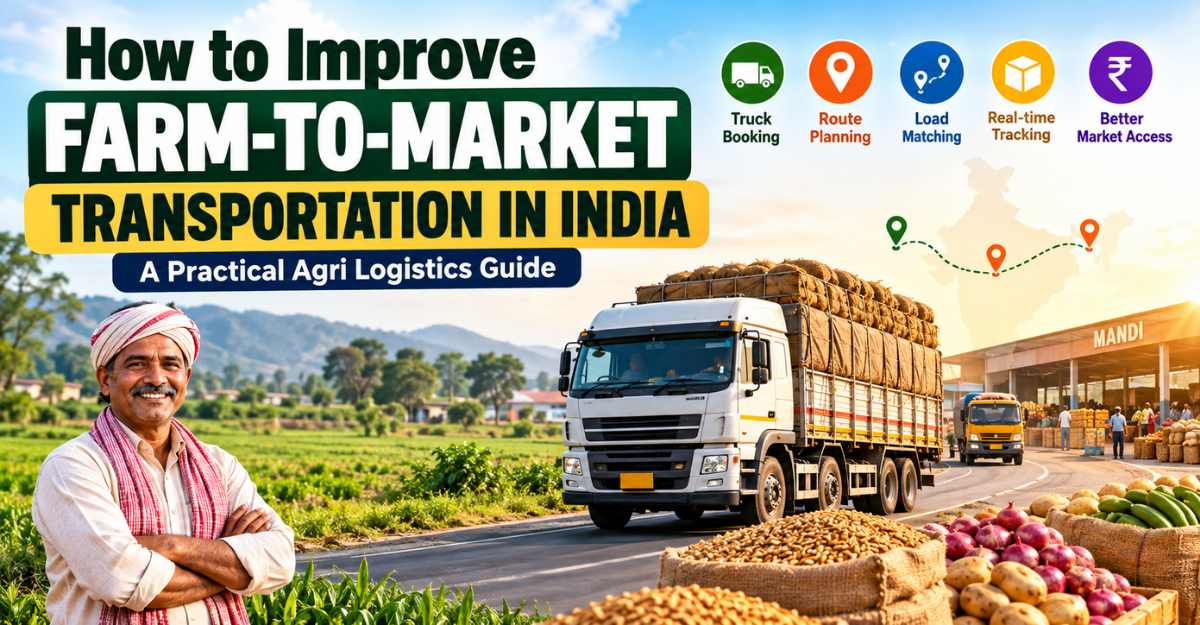
KisanSabha lists shipment tracking and live tracking among the technology features associated with its Agri Logistics service.
5. Match Loads With Available Transport Capacity
Load matching can be useful for both sides of the transportation ecosystem.
For shippers, it can help them find transportation for a requirement.
For transporters, matching available vehicles with suitable agricultural loads can improve utilization.
This becomes particularly relevant for return journeys. If a truck has completed a delivery and a suitable return load is available, better coordination can reduce the likelihood of travelling empty.
KisanSabha identifies load matching as one of the features of its Agri Logistics offering and describes it as a mechanism to improve vehicle utilization.
6. Keep Freight and Payment Details Clear
Transportation disputes can arise when freight expectations, payment terms or shipment details are unclear.
Before dispatch, stakeholders should establish:
- Agreed freight
- Payment method
- Load details
- Pickup point
- Delivery point
- Special instructions
- Expected delivery schedule
Clear information reduces avoidable confusion between the shipper and transporter.
KisanSabha’s platform includes freight and payment-related fields for load-posting workflows, while its Agri Logistics page describes payment coordination as part of the service.
7. Build a Repeatable Transportation Process
For businesses moving agricultural commodities regularly, transportation should not be treated as a separate activity for every shipment.
A repeatable process can include:
Requirement → Load Posting → Transporter Options → Vehicle Selection → Dispatch → Tracking → Delivery → Payment
Once this workflow is organized, it becomes easier to manage recurring transportation requirements.
How Digital Agri Logistics Can Help
Digitalization is changing the way different participants communicate across agricultural supply chains.
Instead of depending entirely on disconnected phone calls, a digital platform can bring load requirements and transportation options into one place.
For example, a farmer or agricultural business can communicate the origin, destination, material and weight of a shipment. Transporters can then evaluate the requirement based on their vehicle availability and route.
This creates a more structured connection between cargo demand and transportation capacity.
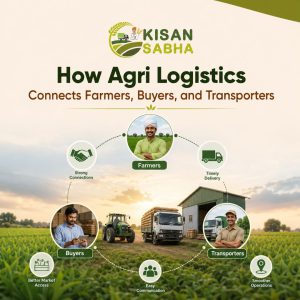
KisanSabha positions itself as a platform connecting farmers, transporters, agricultural service providers, mandi dealers, customers and other agriculture-related entities.
The benefit of such connectivity is not limited to farmers.
For Farmers
Farmers may use an organized transportation platform to:
- Find transportation options
- Plan farm-to-market movement
- Compare available rates
- Arrange transportation for immediate or future requirements
- Track shipments
KisanSabha specifically lists flexible booking options, transporter access and specialized agricultural vehicles among its farmer-focused logistics services.
For Transporters
Transporters need a consistent flow of suitable loads.
A connected agricultural logistics network can help transporters discover cargo requirements, improve vehicle utilization and develop relationships with agricultural businesses.
KisanSabha describes agricultural load access, load matching, payment systems and ratings/feedback as benefits for transporters.
For Dealers and Buyers
For dealers and buyers, reliable transportation is closely connected with inventory and delivery planning.
A delay in transportation can affect when material reaches a warehouse, processing facility, store or customer.
KisanSabha’s service covers connections between farmers, transporters and dealers and includes movement across farms, markets, warehouses and stores.
What Information Should You Prepare Before Booking a Truck?
Before requesting agricultural transportation, having the right information ready can make the process smoother.
A basic checklist includes:
Pickup location: Where should the truck collect the material?
Destination: Where does the load need to be delivered?
Material: What agricultural commodity is being transported?
Weight: Approximately how much material needs to move?
Truck type: What type of vehicle is suitable?
Number of trucks: Is one vehicle sufficient or are multiple vehicles required?
Scheduled date: When should the vehicle report for pickup?
Special instructions: Are there specific loading, unloading or handling requirements?
These are also among the core fields visible in KisanSabha’s load-posting workflow.
Farm-to-Market Transportation: A Simple Example
Consider a farmer or agricultural business with a large quantity of produce ready for dispatch.
Instead of starting with several separate phone calls, the transportation requirement can first be organized around the basic shipment details:
Source: Farm or collection location
Destination: Mandi or buyer location
Material: Agricultural produce
Weight: Total shipment quantity
Vehicle: Suitable truck type
Date: Required pickup date
Once these details are clear, the shipper can look for suitable transportation, compare available options and coordinate the movement.
For a larger business, the same process can be repeated for multiple routes and shipments.
This approach turns transportation from an ad-hoc activity into a more manageable supply-chain process.
Why Farm-to-Market Logistics Matters Beyond the Truck
It is easy to think of agricultural logistics as simply “arranging a truck.”
In reality, transportation connects several stages of the agricultural supply chain.
A crop has economic value only when it can move through the supply chain efficiently enough to reach the next participant.
The journey may involve:
Farmer → Transporter → Mandi → Warehouse → Buyer → Retail/Processing
A delay at one stage can affect the next.
That is why agricultural logistics needs coordination rather than transportation alone.
Digital connectivity can help different participants communicate requirements, identify transportation options and maintain greater visibility over shipments.
How KisanSabha Supports Agricultural Transportation
KisanSabha’s Agri Logistics service is built around connecting agricultural transportation demand with transport providers.
Its stated logistics network includes:
- Farm-to-market transportation
- Market-to-warehouse movement
- Warehouse-to-store movement
- Cross-country transportation
- Local delivery
The service page also lists transporter discovery, shipment tracking, route planning, load matching and payment-related capabilities.
The main website similarly provides a load-posting workflow where users can enter source city, destination city, material, weight, truck type, number of trucks and scheduled date.
For farmers, transporters, dealers and buyers, the objective is straightforward: make agricultural transportation more organized by improving the connection between loads and available transportation.
Frequently Asked Questions
Farm-to-market transportation is the movement of agricultural produce from farms or collection points to mandis, buyers, warehouses, processors, retailers or other destinations.
Efficient transportation helps agricultural produce move through the supply chain according to the required schedule. Better planning can help stakeholders manage vehicles, routes, costs and delivery coordination more effectively.
How can farmers arrange transportation for agricultural produce?
Farmers can prepare key shipment information such as pickup location, destination, material, weight, truck type and scheduled date, and then use a transportation network or platform to identify suitable transport options.
Digital agri logistics uses technology to coordinate activities such as load posting, transporter discovery, route planning, shipment tracking, load matching and payment coordination.
Yes. Agricultural transportation can range from short local deliveries to cross-country movement. KisanSabha’s Agri Logistics service describes both local delivery and cross-country movement as part of its transportation network.
Load matching connects transportation requirements with available vehicle capacity. It can help transporters identify agricultural cargo and potentially reduce empty return trips.
Basic information can include the source, destination, agricultural material, weight, truck type, number of trucks and scheduled date. These fields are available in KisanSabha’s load-posting workflow.
Shipment tracking can provide greater visibility after dispatch. KisanSabha lists live shipment tracking among the technology features of its Agri Logistics service.
The Future of Farm-to-Market Transportation in India
Agriculture is becoming increasingly connected to digital platforms, organized markets and technology-enabled supply chains.
But the fundamental requirement has not changed: agricultural produce needs to reach the right destination at the right time and with appropriate transportation.
The future of farm-to-market transportation is therefore likely to depend not only on more trucks, but also on better coordination between the people who have agricultural loads and the people who move them.
For farmers, this can mean easier access to transportation options.
For transporters, it can mean better visibility of agricultural loads.
For dealers and buyers, it can mean more organized movement between farms, markets, warehouses and stores.
For the wider agricultural ecosystem, better logistics can create stronger connections between production and markets.
KisanSabha’s Agri Logistics service provides a digital platform for coordinating these transportation requirements, with features and network coverage designed around farmers, transporters, dealers and buyers.
Final Takeaway
Improving farm-to-market transportation in India starts with better planning.
Know the load.
Know the route.
Choose the appropriate vehicle.
Plan the pickup.
Compare transportation options.
Track the shipment.
Keep payment and freight details clear.
For farmers and agricultural businesses that regularly need transportation, moving from informal, last-minute arrangements toward a more organized digital process can make logistics easier to manage.
KisanSabha provides an Agri Logistics platform connecting agricultural stakeholders with transportation services for farm-to-market, market-to-warehouse, warehouse-to-store, local and cross-country movement.
The goal is simple: make agricultural transportation more connected, organized, and accessible-from the farm to the market.