
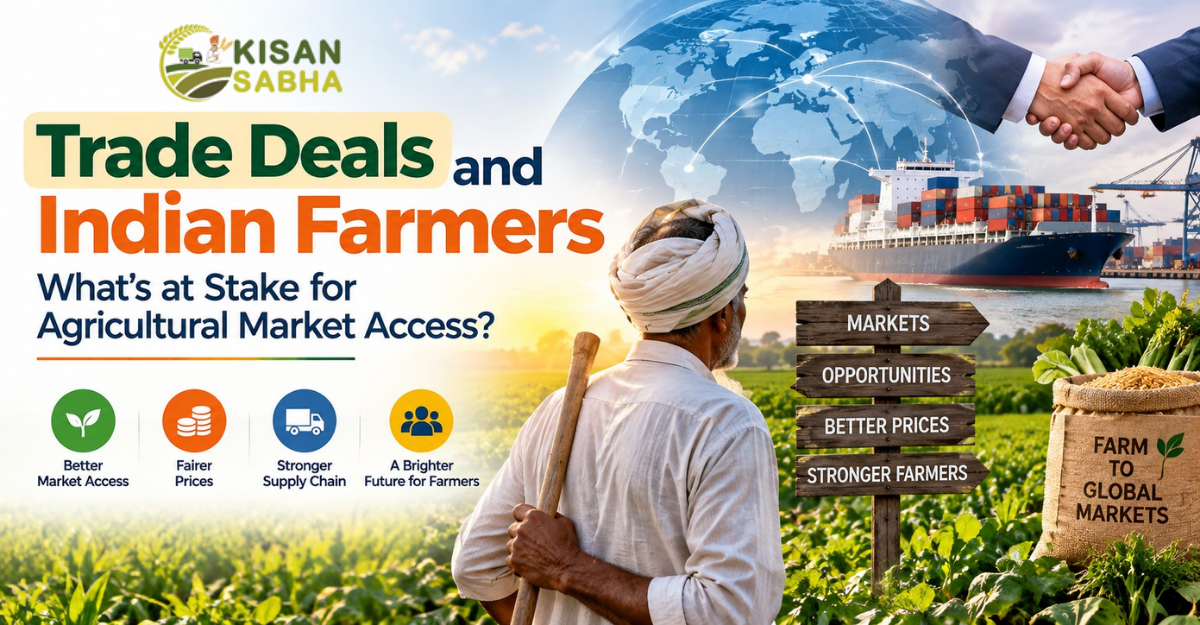
A farmer may never sit at a trade negotiation table, but decisions made there can eventually reach the village mandi.
A change in import duties can influence competition in the domestic market. A new export opportunity can create demand for an Indian crop overseas. A change in trade rules can affect buyers, prices, transportation requirements and the way agricultural produce moves from farms to markets.
That is why the latest farmer mobilisation around international trade agreements deserves attention.
According to a September 4, 2026 report by The Hindu, the Samyukt Kisan Morcha (SKM) has decided to mobilise one million young kisan swayamsevaks to campaign against bilateral and multilateral trade agreements that India has signed or is considering. The report says the organisation also plans village-level kisan panchayats as part of the campaign. Bbilaterals.org
The development has brought an important agricultural question back into focus:
What do international trade deals actually mean for Indian farmers?
The answer is not limited to politics or government negotiations. It reaches into some of the most practical parts of farming—where farmers sell their crops, who buys them, how much they receive, how produce is transported and whether they can reach new markets.
This is where understanding the changing agricultural marketplace becomes important.
Why Are Farmers Paying Attention to Trade Agreements?
Trade agreements can sound like a distant subject involving governments, diplomats and large businesses.
For farmers, however, the consequences can be much closer to home.
When India changes the terms under which agricultural commodities are imported or exported, the balance between domestic supply and demand can change.
Consider a simple example.
A farmer grows an agricultural commodity and takes it to market after harvest. If large quantities of a similar product become available through imports, domestic buyers may have more options. Depending on the commodity, supply and demand conditions, this could influence the price farmers receive.
The opposite situation can also occur.
If an international agreement makes it easier for Indian agricultural products to enter another country’s market, Indian exporters may gain additional opportunities. Increased demand can potentially create opportunities for farmers producing commodities that meet the requirements of that market.
Neither outcome is automatic.
The impact depends on the specific commodity, trade agreement, tariff structure, international prices, domestic demand, transportation costs, quality requirements and many other factors.
That is why the current farmer mobilisation is important to watch—not simply because farmers are discussing trade, but because market access and agricultural prices are closely connected.
What Is a Free Trade Agreement?
A Free Trade Agreement, commonly known as an FTA, is an arrangement between countries that establishes rules for trade and can reduce tariffs or other barriers on selected goods and services.
However, an FTA does not necessarily mean that every product receives the same treatment.
Countries can negotiate different terms for different sectors.
Some products may receive reduced tariffs. Some may be excluded from concessions. Others may be covered by quotas or special safeguards.
This distinction matters greatly in agriculture.
India has a large and diverse farming sector, with millions of farmers producing crops for local, regional, national and international markets.
A policy that affects one crop may have little relevance to another.
For example, an agreement that creates opportunities for an export-oriented crop could be welcomed by producers in that supply chain, while farmers producing a commodity exposed to greater import competition could have different concerns.
This is why farmers and agricultural businesses need access to accurate market information rather than relying only on broad statements about whether a trade agreement is “good” or “bad.”
The Latest Mobilisation and the Wider Farmers’ Movement
The recent report concerns the Samyukt Kisan Morcha, an umbrella platform of farmer organisations.
According to the reported plan, the organisation intends to enrol one million young farmer volunteers and conduct village-level outreach against bilateral and multilateral trade agreements. Bbilaterals.org
The campaign reflects a wider concern among some farmer organisations about how international trade policy could affect agricultural livelihoods.
It is important, however, to distinguish this development from the work of individual agricultural organisations and digital farmer platforms.
KisanSabha.in is not a farmers’ protest organisation.
It is an agricultural marketplace and connectivity platform designed to bring different participants in the agriculture ecosystem together. The platform says it connects farmers with mandi dealers, transporters, agricultural service providers, customers and other agriculture-related businesses. KisanSabha
That distinction matters.
Farmer mobilisation addresses questions of policy, representation and collective demands.
An agricultural marketplace addresses practical market problems such as finding buyers, arranging transportation, connecting with dealers and accessing agriculture-related services.
Both are part of the larger agricultural ecosystem, but they serve different purposes.
What Does Kisan Sabha Mean for Today’s Digital Agriculture Market?
The modern farmer does much more than grow a crop.
After harvesting, the produce needs to reach a buyer. The farmer may need transportation, storage, packaging, agricultural inputs or information about available markets.
In many cases, finding the right person for each part of this process can be difficult.
This is where digital agricultural platforms can make a difference.
KisanSabha describes itself as a platform connecting farmers, mandi dealers, transporters, agricultural service providers and customers across India. Its stated objective is to make communication between these participants simpler and more efficient. KKisanSabha
The platform also allows different users involved in agriculture to register according to their role, including farmers, mandi dealers, transporters, agricultural service providers, consumers and Farmer Producer Organisations. KKisanSabha
In a market that is becoming increasingly connected, these relationships can matter.
From Farm to Market: Why Connectivity Matters
Imagine a farmer has harvested a large quantity of produce.
Growing the crop was only the first part of the process.
The farmer now needs to answer several questions:
- Who is buying this commodity?
- What price is available?
- Which mandi is suitable?
- Can the buyer collect the produce?
- If transportation is needed, where can a truck be found?
- Is temporary storage available?
- Are there buyers outside the farmer’s immediate area?
- Which agricultural service providers can help with the next crop?
Traditionally, farmers may have relied heavily on local networks to answer these questions.
Digital platforms can expand those networks.
KisanSabha says its platform is designed to connect farmers directly with mandi dealers and other participants in the agricultural supply chain. It also provides access to transport and agricultural service networks. KKisanSabha
The idea is simple: better connections can create more choices.
Better Market Access Can Matter as Much as Production
Farmers often focus understandably on increasing production.
Better seeds, irrigation, fertilisers, machinery and farming practices can help improve output.
But producing more is only one side of farm profitability.
The other side is selling effectively.
A farmer who produces a good crop still needs a competitive buyer and a practical way to move the produce to market.
This is where market access becomes important.
KisanSabha’s agricultural marketplace describes its purpose as helping farmers connect with buyers, improving market reach and supporting price discovery. KKisanSabha
This becomes especially relevant when agricultural markets are changing.
Trade agreements can create new potential buyers and new competition. Domestic demand can change. Commodity prices can move. Transportation costs can rise.
Farmers therefore need more than production knowledge.
They also need market connectivity.
How Trade Deals Could Change the Agricultural Marketplace
Suppose a new trade agreement increases demand for a particular Indian agricultural commodity in another country.
The opportunity does not stop at the exporter.
A larger export market may require more produce, reliable quality and dependable logistics.
That can create a chain involving:
Farmer → Aggregator → Trader → Transporter → Processor/Exporter → International Buyer
Every link matters.
If farmers cannot find buyers, the opportunity may not reach the farm.
If transportation is expensive or unavailable, the produce may not reach the buyer efficiently.
If storage is inadequate, farmers may be forced to sell immediately after harvest.
If quality requirements are not understood, produce may fail to qualify for the target market.
This is why trade policy and agricultural infrastructure need to be considered together.
What If Imports Increase?
The other side of the trade discussion is imports.
If an agreement makes imported agricultural products more competitive in India, domestic farmers producing similar commodities may face additional competition.
The actual impact will depend on the commodity and market conditions.
But the situation highlights why farmers need timely information about prices and buyers.
If farmers know what buyers are offering in different markets, they may have more information when deciding where and when to sell.
KisanSabha’s platform is designed around this broader idea of connecting agricultural participants rather than limiting farmers to a single local network. Its website states that farmers can connect with mandi dealers, customers, transporters and agricultural service providers. KKisanSabha
That kind of connectivity cannot eliminate market risk, but it can make the search for market participants more organised.
Why Price Discovery Matters
Price discovery is one of the most important parts of agricultural marketing.
A farmer needs to know what the market is offering before deciding where to sell.
Without sufficient information, farmers may have limited bargaining power.
Digital agriculture platforms are increasingly trying to address this information gap.
KisanSabha’s online agriculture marketplace describes its objective as giving farmers additional options for selling produce and connecting them with buyers, mandi dealers and other agricultural participants. KKisanSabha
The broader idea is not necessarily to replace physical mandis.
Instead, digital connectivity can give farmers another channel through which they can discover potential buyers and services.
More information can help farmers compare options before making a transaction.
Transport Is an Important Part of the Equation
A good buyer is not enough if the produce cannot reach the destination efficiently.
Agricultural commodities can be bulky, perishable or expensive to transport.
For farmers, finding an available truck at the right time can therefore be as important as finding a buyer.
KisanSabha includes transporters as part of its agricultural network and allows transporters to register on the platform. Its FAQ explains that the platform can connect agricultural businesses and users requiring transportation with available transport providers. KKisanSabha
This creates a connection between two problems that are often treated separately:
finding a market and moving the crop to that market.
In reality, they are part of the same agricultural supply chain.
Agricultural Service Providers Also Have a Role
Farmers do not only need buyers.
They also need access to agricultural inputs and supporting services.
This can include:
- Fertiliser dealers
- Pesticide dealers
- Seed suppliers
- Cold storage facilities
- Warehouses
- Transporters
- Other agricultural service providers
KisanSabha specifically lists agricultural service providers, including fertiliser and pesticide dealers, as participants who can use its platform. KKisanSabha
This creates a broader agricultural network in which farmers are not isolated from the other businesses that support production and marketing.
What Can Farmers Do as Trade Discussions Continue?
Farmers do not need to become international trade experts to understand how a trade agreement could affect their business.
A practical approach is to start with the commodity they actually produce.
Know Your Crop Market
Farmers should understand where their crop is being bought and what markets are available.
Compare Buyers
If multiple buyers are available, farmers can compare prices, requirements and payment terms rather than relying on a single source of information.
Watch Market Trends
Changes in supply, demand, imports and exports can influence agricultural prices.
Consider Transportation Costs
A higher quoted price is not necessarily better if transportation costs consume the difference.
Explore New Markets
If demand exists outside the local mandi, farmers and producer groups can explore whether selling to buyers in other regions is practical.
Use Reliable Digital Platforms
Digital agricultural marketplaces can help connect farmers with buyers, dealers and service providers, particularly when local networks are limited.
Why Digital Agriculture Is Becoming More Relevant
Indian agriculture is gradually becoming more connected.
A farmer may now need to think about local mandi prices, online buyers, transportation, storage, input suppliers and even demand in markets far away from the farm.
This does not mean traditional agricultural markets are disappearing.
Instead, digital tools can sit alongside existing systems.
KisanSabha describes its model as connecting participants across the agriculture industry, including farmers, mandi dealers, transporters, customers, agricultural service providers and warehouse owners. KKisanSabha
The objective is to make these connections quicker and more efficient.
That becomes particularly relevant when market conditions change rapidly.
Kisan Sabha and the Changing Role of the Farmer
The modern farmer is increasingly becoming both a producer and a market participant.
Producing a crop remains the foundation, but decisions about selling, transportation, storage and market selection can influence the final return.
This is why farmer empowerment cannot be limited to agricultural production alone.
Farmers also need access to:
Information.
Buyers.
Transport.
Services.
Markets.
Connections.
KisanSabha’s stated mission is to support farmers and other agricultural participants by making these connections simpler and more accessible. KKisanSabha
In that sense, the platform addresses a practical part of the larger agricultural challenge.
The Trade Debate Is Also a Market-Access Debate
The latest mobilisation against trade agreements is ultimately connected to a much larger question:
Who gets access to agricultural markets, and on what terms?
Farmer organisations are raising concerns about how international agreements could influence domestic agriculture.
Governments are highlighting export opportunities and protections for sensitive sectors.
Farmers are concerned about the price they receive.
Buyers want reliable supply.
Transporters need loads.
Exporters need consistent quality.
Consumers want affordable products.
All these interests meet somewhere in the agricultural marketplace.
That is why the trade debate should not be viewed only through the lens of government-to-government agreements.
It should also be understood through what happens after the agreement is signed.
What Should Farmers Watch Going Forward?
As India continues negotiating and implementing trade agreements, farmers can watch several practical indicators.
Import Volumes
If imports of a commodity increase significantly, farmers producing the same commodity may want to monitor how this affects local prices.
Export Demand
If an agreement opens a new market for Indian produce, farmers and producer organisations can watch whether actual export demand develops.
Domestic Prices
Ultimately, the price received by farmers remains one of the most important indicators.
Transportation Costs
Even strong demand is less useful if logistics make the market commercially unattractive.
Storage Availability
Storage can give farmers greater flexibility in deciding when to sell, particularly for commodities that can be stored safely.
Buyer Networks
Having access to multiple potential buyers can help farmers understand their available options.
These factors are closely connected to the kind of agricultural marketplace that platforms such as KisanSabha are designed to support.
How KisanSabha Can Support Farmers in a Changing Market
The current trade debate highlights a simple reality: agricultural markets are becoming more interconnected.
For farmers, this means opportunities may exist beyond the traditional buyer network—but finding those opportunities requires connections.
KisanSabha provides a digital platform where farmers can connect with mandi dealers, buyers, transporters and agricultural service providers. The platform also allows consumers, Farmer Producer Organisations and other agriculture-related participants to register. KKisanSabha
Its agricultural marketplace is designed to make farmer-to-buyer communication easier and provide wider market access. KKisanSabha
For a farmer, the practical benefit is not that a digital platform can predict every price movement or remove every market challenge.
Rather, it can help bring more agricultural participants into one searchable network.
That can be useful when a farmer is looking for a buyer, arranging transportation or searching for an agricultural service provider.
A Changing Agricultural Economy Needs Better Connections
The latest farmer mobilisation around trade deals is part of a much wider conversation about the future of Indian agriculture.
International trade policy can influence agricultural markets, but so can domestic demand, transportation, technology, input prices and changing consumer preferences.
Farmers need to be prepared for all of these changes.
Organisations and movements can raise farmers’ concerns at the policy level.
Digital platforms can address some of the practical challenges that farmers face when participating in the market.
Both forms of participation are different, but they point toward the same larger reality:
Farmers need a stronger voice and better access to agricultural markets.
For the farmer, the final question is often very practical.
Not simply “What does the trade agreement say?”
But:
“Where can I sell my crop, who will buy it, what price can I get, and how can I move it there?”
Those are the questions that determine what happens after policy reaches the farm.
Conclusion
The latest farmer mobilisation against trade agreements has once again brought agriculture and international trade into the national conversation. The SKM’s reported plan to enrol one million young farmer volunteers shows that trade policy is being discussed not only in government offices but also at the grassroots level. Bbilaterals.org
For Indian farmers, the implications of trade deals will ultimately be felt through markets through prices, buyers, competition, exports, transportation and demand.
This is why market connectivity is becoming increasingly important.
KisanSabha is built around that practical side of agriculture. By connecting farmers with mandi dealers, buyers, transporters, agricultural service providers and other participants, the platform aims to make agricultural transactions and communication