
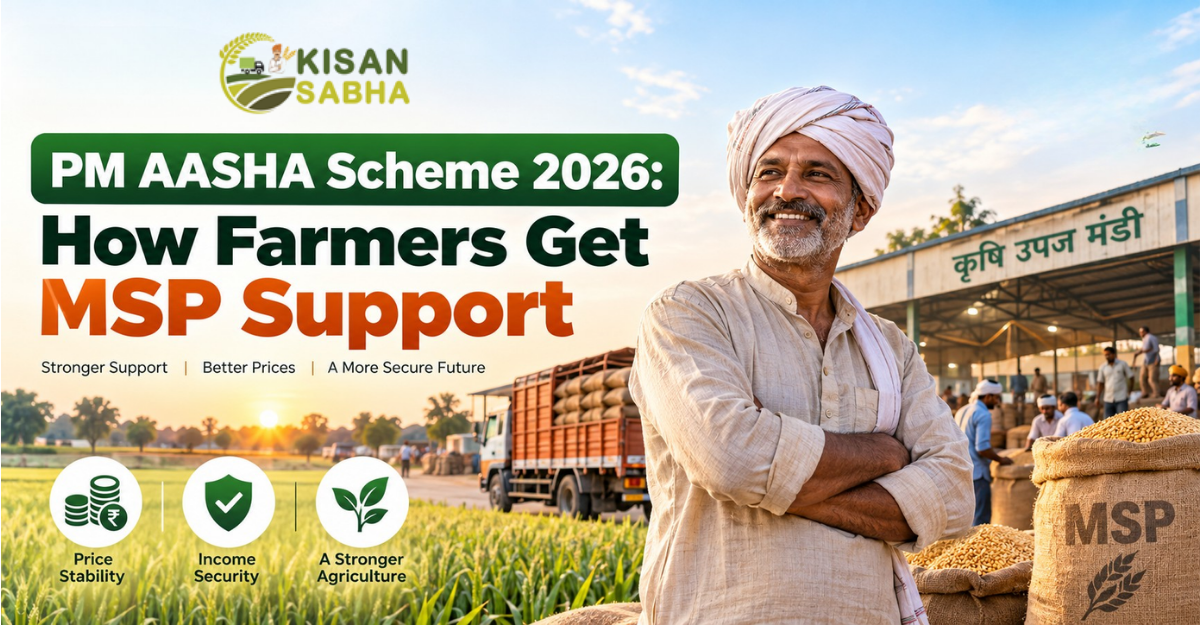
If you sell crops in a mandi, you already know how much a bad price day can hurt. One season the rate is fair, the next season it drops below your cost. The PM AASHA scheme exists to reduce exactly that risk. In 2026, the government has raised the scheme’s budget by a large margin, which means stronger MSP support for farmers across India this year. This article explains what changed, why it matters, and how you can use tools on KisanSabha to act on it.
What Is the PM AASHA Scheme?
PM AASHA stands for Pradhan Mantri Annadata Aay Sanrakshan Abhiyan. It was launched in September 2018 as an umbrella scheme to protect farmer income. The core idea is simple. The government sets a Minimum Support Price, known as MSP, for major crops before every sowing season. But setting a price on paper does not automatically mean farmers receive it in the mandi. PM AASHA is the mechanism that closes that gap.
Without a scheme like this, a farmer growing pulses or oilseeds could end up selling at whatever the local market offers, even if that price is well below MSP. PM AASHA gives the government tools to intervene when that happens, so minimum support price India commitments actually reach the farmer’s pocket, not just the policy document.
What Changed in 2026: A Bigger Budget for MSP Support
According to the Union Agriculture Ministry, the PM AASHA budget allocation has jumped from around 5,400 crore rupees in 2024-25 to more than 7,000 crore rupees in 2026-27. That is one of the largest single year increases since the scheme began.
A bigger budget matters for three practical reasons. First, it allows the government to procure a larger volume of crops at MSP when open market prices fall. Second, it lets state governments act faster during a harvest glut, instead of waiting for funds to be released. Third, it signals that MSP support for farmers is a continuing priority, not a one time announcement.
This increase also comes alongside other farm support measures, including the Agriculture Infrastructure Fund, which has sanctioned over 84,000 crore rupees for storage and logistics projects. Together, these point to a broader push toward price stability and better market access for farmers.
How PM AASHA Protects Farmers from Distress Sales
The scheme’s main job is to prevent what is called a distress sale, where a farmer sells below cost simply because there is no other buyer at a fair price. Here is how the protection actually works in practice.
When mandi prices for a notified crop drop below the declared MSP, government agencies can step in. Depending on the crop and the mechanism used, this can mean direct procurement at government centres, or a cash payment that covers the gap between the market price and the MSP. Either way, the farmer does not have to accept a loss just because private buyers are offering less that week.
This kind of price assurance for farmers changes decision making at the sowing stage too. If a farmer knows there is a safety net for a certain crop, they are more willing to grow it, which helps diversify cropping patterns beyond just wheat and paddy.
The Three Pillars of PM AASHA
PM AASHA is not one single tool. It combines three separate mechanisms, and knowing the difference helps you understand which one applies to your crop.
Price Support Scheme, or PSS, involves the government physically buying crops like pulses, oilseeds, and cotton at MSP through designated agencies. The crop changes hands at a procurement centre.
Price Deficiency Payment Scheme, or PDPS, works differently. Here, the farmer sells the crop in the open market as usual, and later receives a direct payment covering the difference between the market price and the MSP. No physical procurement happens.
Market Intervention Scheme, or MIS, is used for perishables that are not covered under the two mechanisms above, such as tomato, onion, and potato. Because these crops spoil fast, MIS also covers some storage and transport costs, not just the price gap.
Knowing which pillar covers your crop helps you know what to expect, whether that is a procurement centre visit or a bank transfer.
What This Means for Farmers and Transporters
For farmers, the immediate takeaway is straightforward. A stronger MSP support system means less pressure to accept a low price out of desperation. It also means it is worth checking your local mandi rate against the declared MSP before you commit to selling.
For transporters and truck owners on KisanSabha, this news matters too. When procurement increases under PM AASHA, more crop volume moves from farms to mandis and government warehouses in a short window. That creates demand for trucks, especially around harvest season, which is a good time to keep your availability updated on the truck board.
For mandi dealers and agricultural service providers, higher procurement activity also means more transactions passing through APMC yards, which is useful context for planning inventory, storage, and staffing.
How KisanSabha Helps You Use MSP Support Effectively
Knowing that PM AASHA exists is only useful if you can act on it quickly. KisanSabha gives you three practical tools for that.
Start by checking today’s mandi rate for your crop before you decide to sell. Comparing the live rate against the declared MSP tells you immediately whether a PM AASHA mechanism might apply to your situation this week.
If the rate at your regular mandi looks low, use the Mandi Dealer directory to find dealers and contacts in nearby markets who may be offering a better rate, or who can point you to an active procurement centre.
You can also search APMC market details to locate your nearest government notified mandi, since MSP-based procurement generally happens through these official yards rather than private trading points.
Steps to Sell Your Crop at MSP Through KisanSabha
Here is a simple sequence to follow during procurement season.
- Check the current MSP for your crop as declared by the government for this season.
- Compare it against the live rate on the Mandi Rate page for mandis near you.
- If your nearest mandi is offering below MSP, look up nearby APMC yards using the APMC Details page.
- Contact a listed dealer through the Mandi Dealer directory to confirm procurement is active for your crop.
- If you also need transport to move your produce, post your load on KisanSabha to find a truck quickly.
Following this sequence takes a few minutes and can be the difference between a fair price and a rushed, underpriced sale.
FAQ
PM AASHA is a government umbrella scheme, launched in 2018, that combines price support and price deficiency payment mechanisms to help farmers actually receive MSP for their crops, rather than settling for whatever the open market offers.
The budget rose from around 5,400 crore rupees in 2024-25 to more than 7,000 crore rupees in 2026-27, based on figures shared by the Union Agriculture Ministry.
The budget rose from around 5,400 crore rupees in 2024-25 to more than 7,000 crore rupees in 2026-27, based on figures shared by the Union Agriculture Ministry.
No. MSP is the price itself, set by the government each season. PM AASHA is the set of mechanisms used to make sure farmers actually receive that price when the open market falls below it.
Check the latest state-wise MSP list for your crop, then compare it with the live rate on KisanSabha’s Mandi Rate page. If the mandi rate is lower, contact a Mandi Dealer or visit your nearest APMC yard to confirm active procurement.
Sales at MSP typically happen through government-notified APMC mandis or designated procurement centres, not through private traders. Use KisanSabha’s Directory to find verified contacts near you.
Sales at MSP typically happen through government notified APMC mandis or designated procurement centres, not through private traders. Use KisanSabha’s Directory to find verified contacts near you.
No. Coverage depends on the crop and the specific mechanism, PSS, PDPS, or MIS. Major crops like pulses, oilseeds, and cotton are commonly covered under PSS, while perishables like tomato, onion, and potato fall under MIS.
Conclusion
The 2026 increase in the PM AASHA budget is a meaningful signal for anyone selling crops in India this season. It means stronger backing for minimum support price commitments, and less risk of being forced into a distress sale. The best way to benefit from it is simple: check your mandi rate regularly, know your local APMC options, and use verified dealer contacts when prices look off.
Register free on KisanSabha to get mandi rate alerts, connect with dealers, and post your transport needs in one place.