

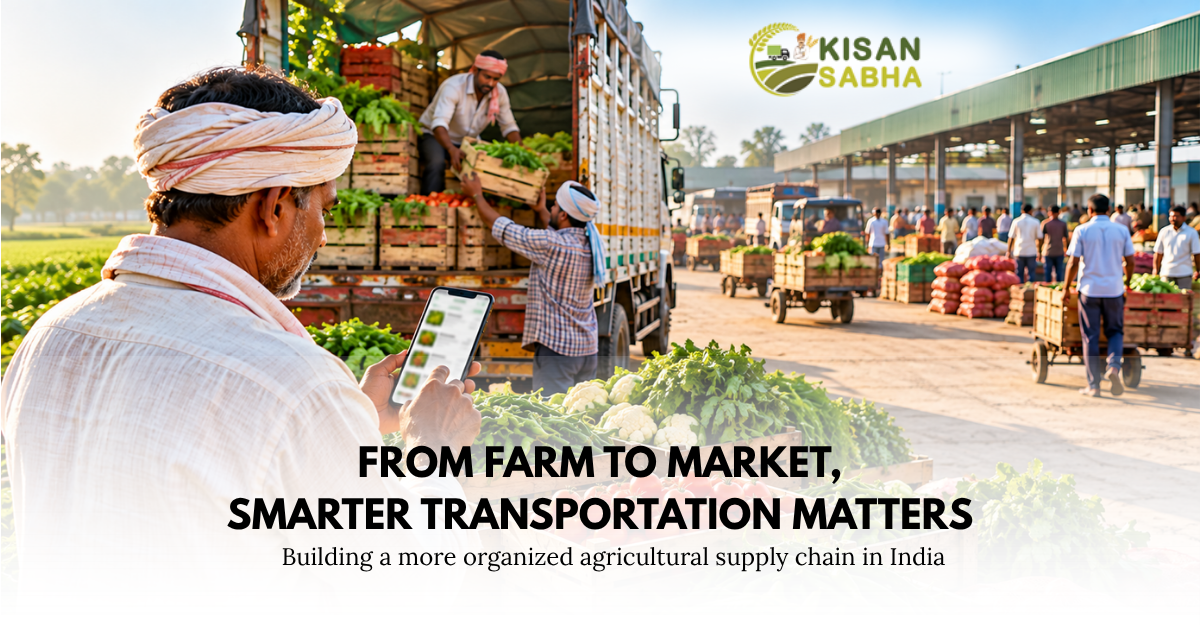
India’s agricultural supply chain does not end when a crop is harvested. The produce still needs to move from the farm or collection point to a mandi, warehouse, processor, retailer, or final buyer.
This makes agricultural transportation in India an important part of the journey from farm to market.
But agricultural transportation is not simply about finding a truck. It involves matching the right vehicle with the right load, planning pickup and delivery, understanding freight costs, coordinating with storage facilities, tracking shipments, and communicating with different stakeholders.
When these activities are handled separately or at the last minute, transportation can become difficult to plan and manage.
A more organized agricultural transportation system can help farmers, transporters, buyers, mandi dealers, warehouses, and agricultural businesses coordinate movement more efficiently.
What Is Agricultural Transportation in India?
Agricultural transportation in India refers to the movement of agricultural produce from farms and collection points to mandis, warehouses, processing facilities, retailers, and buyers.
It can involve the transportation of crops such as grains, pulses, fruits, vegetables, spices, and other agricultural commodities.
Depending on the product and destination, agricultural transportation may involve:
- Truck and lorry booking
- Load-to-truck matching
- Freight planning
- Route planning
- Pickup scheduling
- Shipment tracking
- Warehouse coordination
- Cold-chain transportation
- Delivery management
Unlike many other types of freight, agricultural transportation can be strongly affected by harvest timing, perishability, market demand, weather, storage availability, and destination requirements.
That is why better coordination matters.
Why Is Agricultural Transportation Important?
A farmer can produce a good harvest, but the value of that produce also depends on what happens after harvesting.
If produce cannot reach the intended destination efficiently, problems can arise across the supply chain.
For example, a shipment may experience:
- Delayed pickup
- Difficulty finding a suitable truck
- Unclear freight expectations
- Poor communication
- Unplanned waiting time
- Limited shipment visibility
- Storage coordination problems
- Inefficient return journeys
The Government of India has identified transportation as one of the stages considered in its assessment of post-harvest losses. The NABCONS study commissioned by the Ministry of Food Processing Industries covered 54 crops and commodities across India and examined multiple stages of the post-harvest chain, including transportation.
This makes transportation an important part of the wider effort to improve India’s agricultural supply chain.
What Are the Major Problems in Agricultural Transportation?
The biggest challenge is not necessarily the absence of transportation.
It is often the lack of coordination between available loads, vehicles, routes, schedules, costs, and receiving locations.
1. Finding the Right Truck Can Take Time
Agricultural loads vary significantly.
A shipment may require a particular truck type, capacity, route, and pickup date.
A farmer or agricultural business may have a load ready, while a suitable transporter is available somewhere else. If both sides do not have visibility of each other, the matching process becomes dependent on personal contacts and repeated calls.
A digital load marketplace can make this process more structured by allowing users to search or post transportation requirements.
2. Last-Minute Transportation Planning
Harvesting does not always follow a convenient transportation schedule.
When produce becomes ready for movement, transportation may need to be arranged quickly.
Last-minute booking can create uncertainty around:
- Truck availability
- Pickup timing
- Freight
- Route planning
- Delivery schedules
Better transportation planning starts before the load becomes an urgent problem.
For farmers, FPOs, dealers, and larger agricultural businesses, knowing the expected quantity, destination, required vehicle, and preferred date can make transportation coordination easier.
3. Freight Costs Can Be Difficult to Estimate
Transportation cost depends on several factors.
These can include:
- Source and destination
- Distance
- Truck type
- Load weight
- Commodity
- Toll charges
- Waiting or delay charges
- Additional services
Without a reasonable freight reference, transportation planning can become difficult.
KisanSabha provides a Freight Calculator where users can enter source city, destination city, material, weight, and truck type to obtain an expected freight estimate.
This type of tool can help users plan transportation costs before finalizing a shipment.
4. Limited Visibility After Dispatch
Finding a truck is only the beginning.
Once a shipment starts moving, the farmer, buyer, dealer, warehouse, or other stakeholder may want to know its status.
Without shipment visibility, people may have to repeatedly call the driver or transporter.
Tracking can make communication easier by providing greater visibility into the shipment journey.
This is especially useful when multiple loads are moving at the same time.
5. Empty Return Journeys
Truck utilization is another important consideration.
A transporter may deliver agricultural produce to a destination and then return without a suitable load.
A better-connected transportation network can help identify potential return loads.
This is where load matching becomes useful.
If a truck’s destination and another nearby agricultural load are visible within the same network, the possibility of finding a return shipment becomes easier to explore.
The objective is not simply to put more trucks on the road. It is to make better use of the transportation capacity already available.
6. Transportation and Storage Are Often Treated Separately
Agricultural transportation does not operate in isolation.
A truck carrying produce may be travelling to a warehouse, cold store, processing unit, mandi, or buyer.
If the receiving location is not prepared, the vehicle may have to wait.
This can create additional operational problems.
A more organized agricultural supply chain should therefore connect transportation planning with storage and destination planning.
For perishable commodities, this coordination becomes even more important.
How Does Poor Transportation Affect the Agricultural Supply Chain?
Agricultural transportation problems can affect more than the truck journey itself.
A delayed shipment can influence:
Farmer → Transporter → Mandi → Warehouse → Processor → Buyer → Consumer
If one part of the chain becomes unpredictable, other participants may also need to adjust.
For example:
- A buyer may have to reschedule unloading.
- A warehouse may need to change receiving plans.
- A transporter may lose time waiting.
- A farmer may have to make additional calls.
- A perishable shipment may face greater quality risk.
This is why agricultural transportation should be considered as part of the complete supply chain rather than as a separate trucking activity.
Why Farm-to-Market Transportation Needs Better Coordination
Farm-to-market transportation involves several moving parts.
A typical journey may look like:
Farm → Collection Point → Truck → Mandi/Warehouse → Buyer
At each stage, information needs to move along with the physical produce.
The stakeholders need to know:
- What is being transported?
- How much produce is available?
- Where is it being picked up?
- Where is it going?
- What type of truck is required?
- When should the truck arrive?
- What freight is expected?
- Where is the shipment now?
- Where will it be unloaded?
An organized system can bring these requirements into a more structured workflow.
How Technology Can Improve Agricultural Transportation
Technology cannot solve every logistics problem, but it can make coordination easier.
Digital agricultural transportation platforms can bring multiple activities into one connected environment.
Digital Load and Truck Matching
Instead of relying only on local contacts, users can post or search for loads and transportation requirements.
KisanSabha’s Load Board allows users to search transportation requirements using information such as destination, material, truck type, scheduled date, and load type.
Online Load Posting
A farmer, dealer, or other user can provide information about a transportation requirement, including source, destination, material, weight, truck type, number of trucks, and scheduled date.
This turns a transportation requirement into structured information that can be searched and matched.
Freight Planning
Digital freight calculators can provide an estimated transportation cost based on shipment details.
This does not necessarily replace the final negotiated freight, but it can provide a useful planning reference.
Shipment Visibility
Digital tracking can reduce uncertainty after dispatch and help stakeholders coordinate around the shipment’s expected arrival.
Better Transporter Discovery
An organized platform can help users discover transportation options beyond a small personal network.
This can be particularly useful when demand rises during harvest periods.
What Should an Organized Agricultural Transportation System Include?
A well-organized system should bring together several important capabilities.
| Requirement | Why It Matters |
| Load posting | Makes transportation demand visible |
| Truck discovery | Helps identify suitable vehicles |
| Load matching | Connects transportation demand with capacity |
| Freight estimation | Supports transportation budgeting |
| Route planning | Helps plan movement |
| Shipment tracking | Improves visibility after dispatch |
| Storage coordination | Connects transport with destination capacity |
| Digital communication | Reduces fragmented coordination |
| Transporter information | Helps users find relevant transportation options |
The goal is not to replace every traditional transportation relationship.
The goal is to make those relationships easier to coordinate through better information.
How KisanSabha Can Support Agricultural Transportation
KisanSabha is designed as a digital platform connecting farmers, transporters, agricultural service providers, mandi dealers, customers, and other agriculture-related stakeholders.
Its platform includes transportation-related tools such as load posting, a Load Board, and a Freight Calculator.
For agricultural transportation, this creates an opportunity to bring different parts of the transportation process into a more organized digital workflow.
A farmer can post a transportation requirement.
A transporter can discover available loads.
Users can search transportation requirements using relevant criteria.
Freight can be estimated using shipment details.
This approach can help move agricultural transportation from a purely phone-based coordination process toward a more structured digital network.
Benefits of Organized Agricultural Transportation
Better organization can benefit different stakeholders in different ways.
For Farmers
Farmers can potentially get better visibility of transportation options and plan farm-to-market movement more systematically.
For Transporters
Transporters can discover agricultural loads and explore opportunities to improve truck utilization.
For Mandi Dealers
Better shipment information can make inbound and outbound transportation easier to coordinate.
For Buyers
Better transportation visibility can support receiving and delivery planning.
For Warehouses and Cold Stores
More predictable transportation schedules can make receiving and dispatch planning easier.
For Agricultural Businesses
Digital transportation information can help businesses coordinate multiple shipments and make logistics planning more systematic.
Agricultural Transportation and Post-Harvest Losses
Transportation should also be viewed in the context of India’s wider post-harvest challenge.
Government studies have estimated post-harvest losses across different agricultural commodities. The NABCONS 2022 study reported estimated overall loss ranges of 6.02%–15.05% for fruits and 4.87%–11.61% for vegetables.
These figures represent broader post-harvest losses and should not be interpreted as transportation-only losses.
That distinction is important.
Post-harvest loss can occur across several stages, including harvesting, collection, grading, packaging, transportation, storage, processing, and market-level movement.
Therefore, improving transportation should be part of a wider strategy that also includes appropriate storage, handling, packaging, cold-chain infrastructure, and better supply-chain coordination.
What Can Make Agricultural Transportation More Efficient?
There is no single solution.
A more efficient agricultural transportation ecosystem requires coordination across several areas.
1. Plan Before the Load Is Ready
Expected harvest quantities and destinations can be considered before transportation becomes urgent.
2. Make Loads Visible
Digital load posting can make transportation requirements easier for transporters to discover.
3. Match Loads With Suitable Trucks
Truck type, weight, location, destination, and date should be considered when matching transportation.
4. Improve Freight Transparency
Estimated freight information can help users make better transportation decisions.
5. Track Shipments
Shipment visibility can improve communication between different stakeholders.
6. Connect Transportation With Storage
Transport planning should consider the receiving facility and storage requirements.
7. Improve Return-Load Opportunities
Matching return loads can potentially improve truck utilization and reduce unnecessary empty movement.
The Future of Agricultural Transportation in India
India’s agricultural supply chain is becoming increasingly connected to digital platforms, organized logistics, storage infrastructure, and technology-driven market access.
But technology alone is not the objective.
The real objective is better coordination.
A farmer should be able to communicate a transportation requirement clearly.
A transporter should be able to discover suitable loads.
A buyer should have better visibility of an incoming shipment.
A warehouse should know when a vehicle is expected.
And businesses should have better information to plan agricultural movement.
This is what a more organized agricultural transportation ecosystem can look like.
The future of farm-to-market transportation is therefore not simply about adding more trucks. It is about connecting loads, vehicles, freight information, routes, storage, and people more effectively.
Frequently Asked Questions
Agricultural transportation helps farmers move harvested produce to markets and buyers. Better transportation planning can make movement more predictable and can support wider market connectivity.
Major challenges include finding suitable trucks, last-minute booking, uncertain freight costs, limited shipment visibility, poor coordination with storage, delays, and inefficient return journeys.
Farmers can use transportation platforms and load boards to post shipment requirements and search for available transportation. KisanSabha provides online load-posting and load-search functionality.
Technology can improve transportation by making loads visible, helping users discover trucks, supporting freight estimation, improving shipment visibility, and bringing different stakeholders into a connected digital workflow.
Farm-to-market transportation is the movement of agricultural produce from a farm or collection point to a mandi, warehouse, processor, retailer, or buyer.
Load matching connects transportation demand with available truck capacity. It can help farmers find suitable transportation while giving transporters more visibility of available loads.
Freight estimation provides a reference for transportation planning. It can help farmers, dealers, and businesses understand the expected cost of moving a particular load before finalizing transportation
Tracking provides greater visibility after a shipment has started moving. It can help stakeholders coordinate delivery, receiving, unloading, and communication around the shipment.
No. Agricultural transportation is one component of agri logistics. Agri logistics is broader and can include transportation, storage, warehousing, cold-chain management, packaging, distribution, and supply-chain coordination.
KisanSabha provides digital tools for agricultural stakeholders, including load posting, a Load Board, and a Freight Calculator. These tools are designed to support coordination between farmers, transporters, and other agriculture-related participants
Conclusion
Agricultural transportation in India is more than moving a truck from one city to another.
It is the connection between agricultural production and the market.
When transportation is difficult to plan, information is fragmented, freight is uncertain, or shipments have limited visibility, the effects can extend across the wider agricultural supply chain.
A more organized approach can bring farmers, transporters, buyers, dealers, warehouses, and other stakeholders closer together.
Digital tools such as load boards, freight calculators, online load posting, and shipment visibility can help create this coordination.
The goal is simple:
Move the right agricultural produce, in the right vehicle, at the right time, with better information from pickup to delivery.
As India’s agriculture ecosystem becomes increasingly digital, better-organized transportation can become an important part of building a more efficient and connected farm-to-market supply chain.