
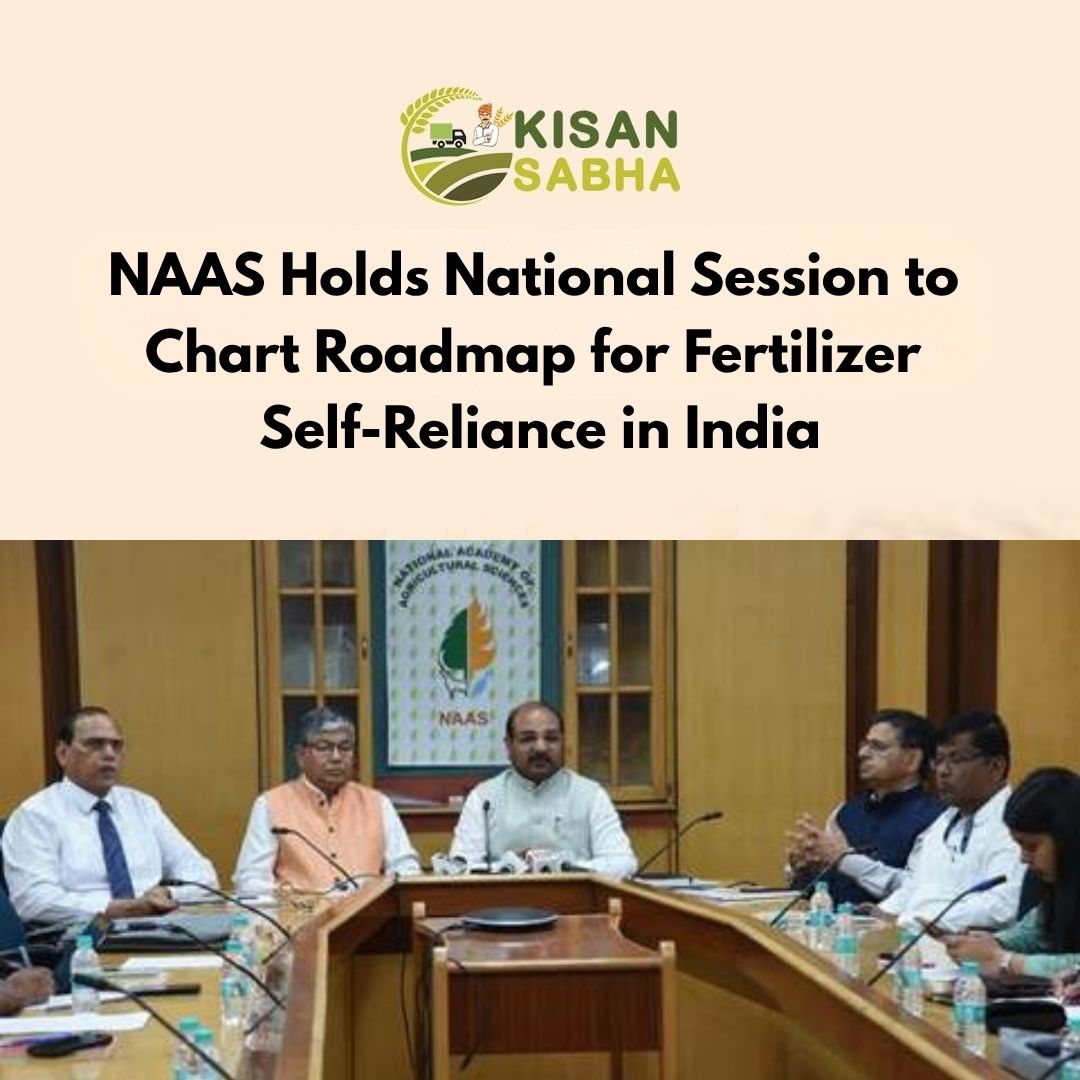
New Delhi: The National Academy of Agricultural Sciences (NAAS) recently organised a high-level brainstorming session focused on developing a comprehensive roadmap for achieving Atmanirbharta (self-reliance) in fertiliser production and use in India. The event brought together representatives from government departments, scientific institutions, the fertiliser industry, agricultural experts, and farmers to discuss strategies for a more sustainable and self-sufficient fertiliser ecosystem.
Setting the Vision for Self-Reliance
During the session, participants unanimously emphasised the need to reduce India’s heavy dependence on imported fertilisers, which currently accounts for a significant portion of the country’s annual usage. According to government data, India consumes nearly 33 million tonnes of fertilisers each year, much of which is still imported.
Dr. M.L. Jat, Secretary of the Department of Agricultural Research and Education (DARE) and Director General of the Indian Council of Agricultural Research (ICAR), highlighted that achieving Atmanirbhar Bharat by 2047 will require innovation, efficient nutrient management, and strong policy support. He noted that while fertilisers played a central role in the Green Revolution and India’s food security achievements, inefficient and imbalanced use remains a challenge today.
Strategies for Sustainable Fertiliser Use
Experts at the session recommended a multi-pronged approach that includes:
- Promoting precision nutrient management using modern tools like artificial intelligence and sensor-based systems.
- Strengthening soil health initiatives and balanced fertiliser application based on soil nutrient needs.
- Encouraging crop diversification, particularly towards pulses and oilseeds, which reduces dependency on chemical fertilisers.
- Enhancing the use of organic and biological sources and recycling agricultural waste.
- Developing alternative fertilisers and leveraging indigenous mineral resources.
Participants also urged the launch of a Mission Mode Programme for Integrated Nutrient
Supply and Management (INSAM), with a target of replacing at least 25% of chemical fertiliser usage with organic alternatives within three years.
Read More:- Future of Farming: Top 5 Sustainable Agriculture Trends
Policy Reforms and Farmer Benefits
The session stressed the importance of policy reforms in the fertiliser sector, including:
- Moving towards a nutrient-based subsidy system.
- Linking subsidies with soil health card recommendations.
- Exploring direct cash transfers for farmers to encourage efficient fertiliser use.
Experts also pointed out that subsidised pricing for urea has inadvertently led to its overuse, while more balanced application of phosphorus and potassium is needed to maintain soil fertility.
What This Means for Farmers & India’s Agriculture
For India’s farming community, the outcomes of this session are significant. Efficient fertiliser use can improve crop productivity, reduce input costs, and support long-term soil health – all of which are essential for sustainable agriculture. Platforms like KisanSabha help farmers stay informed about such policy discussions and market trends, enabling them to adopt best practices and access new agricultural opportunities.
By connecting farmers with the latest insights, mandi updates, and solutions for efficient nutrient management, KisanSabha aims to support the journey towards a more self-reliant and profitable agricultural sector.